The World of Tomorrow
I have a geeky affinity for World’s Fairs that’s a tad anachronistic for a red. World’s Fair geeks are a bit like Disney fans or Michael Jackson supporters: optimistic naifs who believe in all that is good, pure and innocent and who view the future through rose-colored glasses. At their peak, World’s Fairs were heavily commercialized, globally competitive and naively focused on different themes of progress through technology. That’s why I find them so attractive.
The roots of my World’s Fair obsession lie in my last semester at Queens College, which, due to my dedication to activism over education was an autumn super-senior semester. The year was 2001. I had finished my courses in Labor Studies and Journalism, and budget cuts prevented me from taking that last Economics course, “Economics of the Labor Force,” (what the hell kind of economy would we have without labor?) that would have earned me a second Associates degree, so all I had left was to burn through 15 elective credits. I had fun and took art classes and studied urban planning, a budding interest at the time.
The Chicago World’s Fair of 1893 is a hallmark of urban planning. It was the first World’s Fair held in America, and its theme center, the “White City,” a collection of gleaming white buildings of uniform height and roman architecture inspired civic leaders to ask “Why don’t our cities look like that?” Developed by disparate market forces, American cities lacked the thematic unity of European cities like Versailles and Dresden. The World’s Fair inspired cities to consider zoning laws that would emphasize aesthetics as well as practical usage. World’s Fairs continue to be influential on American society through the 1939 New York World’s Fair.
The world as we know it changed forever two weeks into my final semester in college. Campus lore has it that dozens of students and faculty gathered below the Goodman-Chaney-Schwerner clocktower on Tuesday, September the 11th, and watched the Twin Towers collapse on the horizon. I wouldn’t know. I didn’t leave my basement for a week.
When I returned to campus, I began reading about the 1939 World’s Fair, New York’s first. The most striking physical element of the fair was its theme center: two perfect geometrical shapes in art deco style, the Trylon and Perisphere. The Perisphere was a 300 foot high globe, inside of which were held presentations on “the World of Tomorrow.” The Trylon was a three-sided spike that rose 700 feet in the air. It was a skyscraper, visible from Manhattan.

It is immediately reassuring, in a perverse way, to read of a skyscraper – a landmark – that was here and then gone. That is New York, after all. It’s always changing. It’s amazing that so many of us claim to love it. Love what? The memories of what used to be?
Beyond the iconography, the 1939 World’s Fair featured more of that naive faith in constant advancement through technology that is all the more shocking and enviable since it came right before the worst horrors of the century. Corporate exhibits extolled the virtues of automation, which would provide us all with more leisure. General Motors presented a working model of the city of the future (which looked a lot like Brasilia) in which cars and highways would zip us through our commutes. Television was publicly unveiled and promised to be the most amazing educational tool man had ever created. The people who went to the World’s Fair could not imagine that such inventions could have downsides. They certainly couldn’t imagine inventions of pure evil and destruction, like nuclear bombs. And I’m sure they couldn’t imagine objects of wonder like skyscrapers and aeroplanes could be converted into weapons of mass destruction.
It’s not like ugly reality didn’t come crashing in on this Fair. The second World War broke out at the end of its first season. The nations of Poland and Czechoslovakia ceased to exist in the rest of the world, although their pavillions continued operation at the World’s Fair. In the midst of the global tensions, the Soviet Union withdrew its exhibition, which featured a giant statue of a working man holding aloft a red star as though he was grabbing a strap on the Lexington Avenue subway.

When the Fair reopened for its second season, the theme became “For Peace and Freedom,” and advertisements emphasized the many flags of the world flying together. That, too, was endearingly naive.
In the end, the Trylon and Perisphere also became weapons of destruction. They were torn down, and their steel frames were converted to armaments for the war effort.
Fairgoers who attended General Motors’ “Futurama” exhibit were given a button to wear that bragged: “I have seen the future.” But they hadn’t, the lucky bastards.

For more information: The Iconography of Hope: the 1939-1940 New York World’s Fair
A Happy Fun Adventure
I killed a cat today. I was walking Elana back to the J train. She asks if we could go to the cheap fruit stand and buy some pineapple. I tell her it’s a little out of the way, but we go anyway. We turn the corner and walk down Jamaica Ave. under the elevated train tracks. Before we walk ten feet we spot a cat in the road. “Ooh, kitty,” she says in that voice that’s affected for babies and kittens, “get out of the way if you don’t want to get hit.”
The cat looks dazed. It’s walking in front of cars, slowly and off-balance. It stands in front of a car that’s stopped at the red light. The light changes, and the driver has to back up and turn to avoid the cat, who’s barely moving. We surmise that it’s been hit by a car and debate what to do. “There’s an animal hospital nearby,” I say. She starts emptying her bag so that we can have something to carry the cat in, but the cat’s still walking into on-coming traffic. I need to get him out of the road now. I walk towards the cat and bend to pick him up, but I hesitate. He’s a mess. I don’t even know how to carry a healthy cat, let alone a badly injured one.
Some guy yells at me from down the street. He’s carrying lumber, I assume for the construction site two blocks away. “Jus’ pick up da fuckin’ cat,” he yells helpfully, “he ain’t gonna hurtcha.” This guy’s one of these New York characters. I don’t see him picking up the goddamn cat. But I do, finally. I’m not gonna put him in a bag, though, like roadkill. I carry him in my arms. He’s dirty and he smells, and I worry about my dry cleaning bill, to tell the truth.
Elana’s shaken up. She apologizes for not being much help, and says she has to walk ahead of me because it’s too upsetting. I ask her if I’m holding the cat right. She tells me I am. Because she’s walking ahead, she gets to the animal hospital first. When I walk in the lobby, she’s already talking with the vet, who’s explaining the situation. It’s about the delicate matter of the cost. The city-run animal shelter is a few blocks further, he tells us. They won’t charge, but they are required to euthanize strays. We ask him how much money, and he says about $50, just enough to cover the expense, which we agree to pay.
He brings us to an examination room, but he has a few other matters to attend to before he can examine the cat. I put the cat on the table and he starts walking in a daze again. He’s gonna walk right off the table. I hold him down a bit by petting him. “Calm down, kitty,” I say in that baby/kitty voice. I joke with Elana that “I guess I bought myself a damn cat, if he pulls through.” I see the cat’s face for the first time, and see now why Elana had to walk ahead. He’s a gooey mess. His mouth is open in the shape of an “o” and it’s oozing green snot. He’s still restless, but I calm him and he curls his body against my arm.
The vet returns. He feels the cat’s body and doesn’t think anything’s broken. “I’m not sure he was hit by a car,” he says. “If he’s unspayed, he’s probably feral.” The vet checks and is right. This is nobody’s cat. He was sick, and walking in the street to die. Elana leaves the room. The vet asks me to stay with the cat for a moment while he gets the medicine. When he returns, his assistant brings me to another room where I can wash my hands while he puts the cat down.
I join Elana in the lobby. She apologizes again, but she felt dizzy, which is understandable. I tell her I need to go to the ATM. She says she has her checkbook with her, but I tell her my bank has an ATM just two blocks away and that I’ll be back in five minutes.
The ATM is across the street from the fruit stand that we wanted to go to. I go inside, but there are no pineapples. Of course.
When I return to the animal hospital, Elana’s settling up the bill with the vet. It’s only $35. I give her a $20. We leave and separate. She, to Williamsburg; me, to the dry cleaner.
At the cleaners, I empty my pockets and remove my coat. The lady at the counter does the usual inspection. “Missing a button,” she notes. “Yeah, and this pocket’s torn and the lining’s all ripped up,” I tell her to make clear that I won’t hold the establishment responsible for that. “I just have to make do for the rest of the season,” I continue. “Yes, more storms coming,” she says in her Chinese accent, while fishing through a container of loose buttons. “A ha,” she says, as she finds a perfect match for my missing button and smiles.
This story has no moral, except that we should all heed Bob Barker’s advice and spay and neuter our pets. I would have taken that coat to the cleaner another day, and she would have found the button then instead, or I would have just thrown that old coat out in the spring. God does not work in mysterious ways and all things do not happen for a reason. I suppose we gave that cat some comfort in his last minutes, but I didn’t stay for his last minute. I left to wash my hands.
Grave Concerns
Today’s newspaper is sure to make one consider some grave options. First, there’s Hunter S. Thompson, who, before blasting himself away on Sunday, left instructions to have his cremated remains blasted from a cannon. Second, is the far more grim news that the New York City medical examiner’s office has given up identifying the remains of 1,161 victims whose bodies could not be identified or were never recovered from the World Trade Center attack.
Many families of victims have delayed holding services, awaiting discovery of all or part of their loved ones. Others have buried partial remains only to have more parts discovered later.
This post is not meant to take anything away from those families’ grief, or from their desire to mark the lives of the ones they lost. I just don’t understand the need that people feel to have a proper funeral.
If I had a spiritual bone in my body, I would describe myself as a secular humanist, but I don’t, so I’d rather be defined by my lack of beliefs and simply call myself an atheist. As such, I just don’t feel any sense of proprietorship over my body once I’m dead. I don’t feel a need for a proper burial, and I don’t really understand why anybody else would feel the need either.
Cemeteries are pretty. I like to walk around Maple Grove Cemetery, with its well-kept lawns, shady trees, curious tombstones and squirrels, ducks and turtles. Don’t call me morbid. As I’m fond of pointing out to my friends, cemeteries were the first urban parks in the early industrial era. Civic leaders found the idea of people having picnics in cemeteries to be a little distasteful and so parks like Boston’s Public Garden and New York’s Central Park were created.
Most cemeteries aren’t even as pretty as Maple Grove. They’re less historical, less ornate; just big lawns punctuated with concrete slabs. It just seems like a terrible use of real estate, and I don’t want any part.
Consider this my Last Will and Testament. When I die, take my organs (the liver will likely be of no use to anyone, but the lungs are clean), cremate my remains and spread my ashes over the Meadow Lake (the former “Lagoon of Nations” of the World’s Fair) in Flushing Meadows.
If anyone feels the need for a physical marker to remember me (What, I ain’t memorable enough as it is?), be creative! For example, I received a fundraising call from Queens College a few weeks ago. Donors who give at least a certain amount will be memorialized with a brick near Powdermaker Hall. Now, that’s what I consider a fitting marker. Not only would it take up very little space (which is still be utilized for a worthwhile purpose), but it would support a worthy public institution that has benefitted me and in which I truly believe. Moreover, I couldn’t think of better company than the Freedom Ride martyrs Andrew Goodman, James Cheney and Michael Schwerner.
Save the Plaza
There’s long been speculation that the Plaza Hotel would close its doors. Hotels don’t seem to have a very long shelf life these days. New amenities are rolled out by competitors, new audio-visual and networking technologies are introduced, new demands are made of conference and banquet space. New hotels can build for the modern marketplace, but older hotels have to pay a fortune to be retro-fit. Add to that the usual wear and tear that a hotel goes through (carpets wear thin, wallpaper fades and let’s not talk about those mysterious stains that turn up in the strangest places), and you wind up with the need for a hotel to close operations for top-to-bottom renovations every couple of decades. Many hotels decide to forgo the renovations. They close down, tear down, go condo.
The Mayflower, the Stanhope and the Regent Wall Street are just a few of the hotels that have closed their doors in the past year. They’ve been supplanted new hotels like the Mandarin Oriental in the Time Warner Center and the so-hideous-it’s-beautiful Westin in Times Square. This cycle of openings and closings has been going on for a long time, which is why there’s been speculation about the fate of the Plaza for such a long time. The question comes up every time the hotel is sold. Donald Trump made some vague threats to go condo when bought the hotel in 1989, but that was just some macho posturing against the hotel workers union.
The truth is that the hotel has looked the worse for wear for a little too long, so when Elad Properties bought the hotel recently, nobody was surprised when they announced that the hotel would close for renovations in April and reopen as a mixed-use building, with condo apartments, retail space and a much smaller “boutique” hotel in one part of the building.
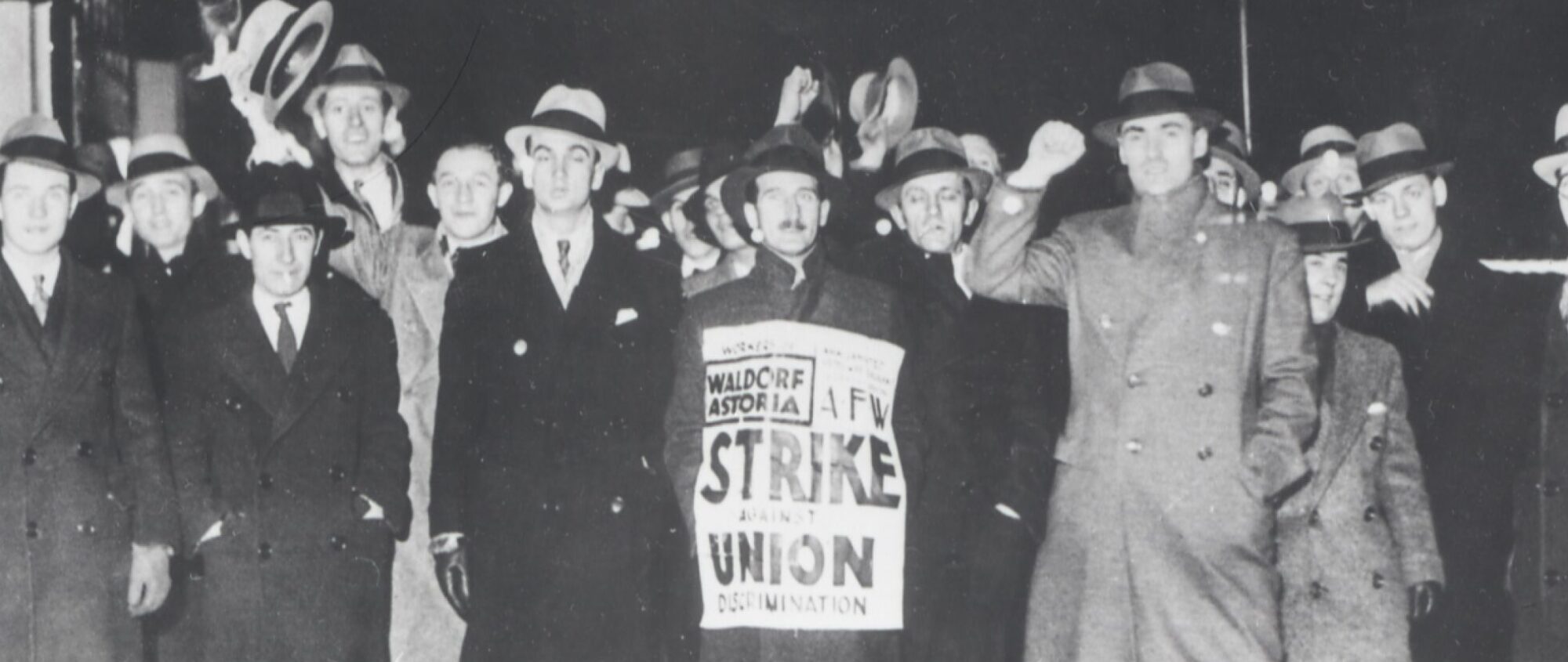
The hotel workers union rallied in front of the Plaza yesterday. The union has formed a Save the Plaza Coalition. They’re enlisting support from politicians, celebrities and members of the community. They’re filing for landmark status for interior sections of the hotel, but the company was likely to preserve that famous dining rooms like the Oak Bar and the Palm Court anyway.
A spokesman for Elad told the Daily News, “This isn’t about landmarks, this is about losing 900 jobs at the hotel.” So what if that’s the case? Since when are 900 working people’s livelihoods of no concern? That’s 900 people with good pay, health care and seniority. That’s an awful lot of middle-aged waitresses, cooks and room attendants having to compete with younger workers for new jobs that won’t pay nearly as much or have the same benefits and security. Elad’s callousness is astounding.
The Plaza will be saved. The building itself is a landmark and is in no danger of being torn down. The famous interiors of its lobby and dining rooms will likewise win landmark status and will remain open to the public. What is in danger of being lost is hundreds of jobs if the hotel closes the vast majority of its guest rooms to the public. I don’t support tax breaks as a solution to keep wealthy owners making a profit. I do think public pressure might convince Elad that gutting the Plaza is not worth their time, and the publicity might inspire a group of buyers to get together and “save the day.” Maybe Donald Trump will buy back one of his formerly prized possessions. He could make a TV show about the renovations. That might pay for the hotel right there.