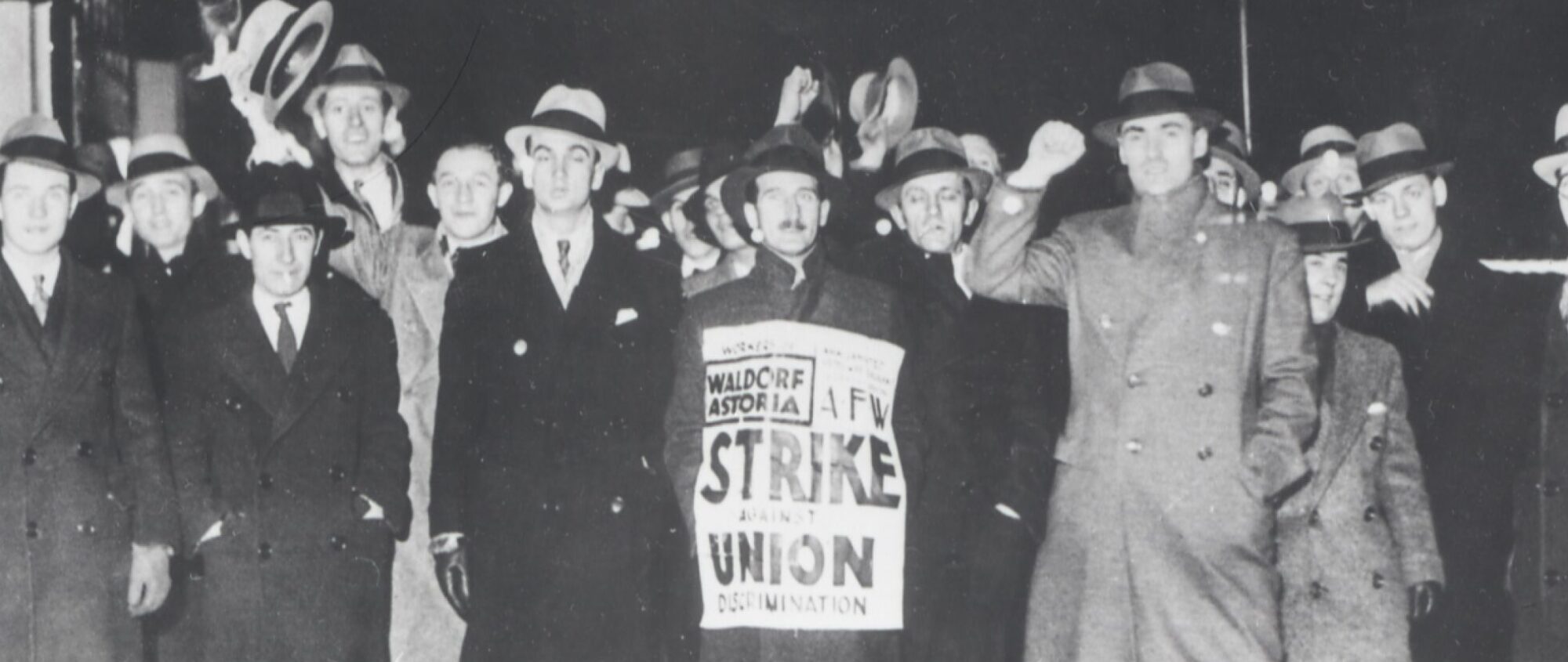
Why “Comrade?”
A friend and, dare I say, comrade wrote me and asked why I use the word “comrade” so freely, instead of the more accepted “brother” and “sister.” Won’t people associate you with James Bond villains and bomb-throwing radicals when you use that word? And it’s true. I do throw it around a good deal, both as a warm expression of solidarity and friendship and, a little bit, to make people a bit uncomfortable in otherwise stodgy rooms.
Fuck it; I’ve already been blown up by Fox News for being dangerously un-American, so why pretend to be a safer person than I am? Besides, saying “brother” or “sister” instead of comrade is one of those bits of American exceptionalism, like not celebrating Labor Day on May 1 or calling football “soccer,” that really ought to be resisted as a matter of global solidarity. Comrade is the preferred salutation of the labor movement in most countries. Perhaps it gets lost in translation? The British default to comrade, but, being British, they pronounce it funny (“comb-rayd”).
I was a teenage socialist. I joined the Socialist Party when I was 17 years old. Although I’ve since quit the party, I remain a socialist. In socialist politics, we say comrade. We even abbreviate it as “Cde.” in the minutes (“Cde. Richman seconded the motion”). It was when I first started saying the word and where I first gained an appreciation for its meaning.
Firstly, the word conveys a sense of equality that brother and sister don’t quite get across. As I said, I was a teenage socialist. But I was a comrade, on equal footing and with equal title as people who had been in the movement for decades; people who had been trained by Bayard Rustin, A.J. Muste, Michael Harrington. I was their comrade.
When I organized a teach-in against one of those many little Clinton wars at Queens College with one of my professors, he called me comrade. Of course, he’s British; it comes easier to him. But it was a tremendous equalizer. I still see him at rallies or union meetings and he still greets me with a warm, “Hello, comrade. How are you?”
I first started using the word in a union context as a dare. A bunch of my co-workers marched together under no banner in the first huge march against the proposed invasion of Iraq. It was an unseasonably warm early spring day. There were a million of us. It felt like a celebration (and then the war started).
At some point during the march, my friend Alan and I found ourselves separated from our group. “It appears we have misplaced our comrades,” I said. Alan paused, laughed and challenged me, “How amazing would it be if you and I called each other comrade at the office on Monday?” And so we did, and so we have ever since.
It’s significant to this story that one of our friends at the union was trans, but not yet out. Hell, he wasn’t even out to me but it just felt wrong to call him sister. Comrade, as a gender-neutral salutation, just made practical sense. This old word has some relevance to the 21st century yet!
Finally, comrade is used in the military. The salutation is standard at VFW halls. (What could be more American than that?) To me, comrade implies that we’ve been through some shit together; a tough campaign, a boss fight, some controversy. And there’s a greater loyalty that comes out of having been through some shit together. Calling someone a comrade, for me, is about trying to always keep that first and foremost. It’s too easy to get into an argument of some immediate political issue or campaign decision and just go to war or give someone up as dead to you. But you don’t do that with a comrade. You’ve been through some shit.
You could argue that brother and sister do all of this equally well (well, not the whole gender neutral thing). But I would say that those salutations in labor have become a bit too pro forma. They are said to fill the air, with not much deep thought behind them. Saying comrade, in America, in the year 2015, requires more of a thought process. And I’m generally in favor of people doing more thinking.
Tuli’s Archives
Gothamist has a pretty incredible story about some newly discovered Bob Dylan lyrics, to a song-never-recorded about Robert Moses. It’s easy to assume that the lyrics sheet is a hoax. But, because, it was discovered in the Tuli Kupferberg files, I’m inclined to regard it as legit.

Tuli was a true American character. He was a member of the musical avant garde jug-band the Fugs, an early progenitor of the Village underground, a leftist and a proto-zinester. I first learned of him when, accompanied by a (paid!) intern, I poured through David McReynolds’ archives to find suitable material for the Socialist Party’s 100th anniversary conference journal.
McReynolds was a long time leader of the SP, a pacifist and student of Bayard Rustin and A.J. Muste, a two-time candidate for President (I managed his second campaign in 2000; his first, in 1980, is purportedly the first time that an openly gay man ran for the office) and a long-time bohemian and Village resident. Before David complains about this post, I use the past tense because I am describing an event from 2001, not because he is dead. He is very much still alive (and blogging!).
David’s archives included many incredible photographic negatives of Socialist Party and War Resisters League events from the prior 40 years, including some of the last “new” pictures of Martin Luther King – from a WRL (or possibly Fellowship of Reconciliation?) – awards dinner in the early 1960’s.

It also included a shot from that same dinner night that I has developed into a 11″ x 14″ print that has adorned the walls of every home I have since called my own, of A.J. Must and Norman Thomas locked in an intense yet casual conversation at that same awards dinner, (I think) with the glass reflection of MLK’s back behind them.

So, what convinces me of the authenticity of these new Dylan lyrics because they were found in Tuli’s archives? Well, many of Tuli’s archives wound up in McReynolds’ archives – most notably a zine called “FUCK GOD!” When we came across that one, McReynolds chuckled and said, “That was pretty controversial back in its day. I don’t know how Tuli got away with that one!”
A few minutes later, I came across Tuli’s sequel to that particular opus, a mimeographed volume entitled, “FUCK GOD IN THE ASS!,” its cover adorned by a crude line drawing of a be-robed man with long grey hair, from behind, spreading his butt cheeks. “Yeah,” I said, “I think this would still be pretty controversial today.”
So, do I think it’s possible that young Bob Dylan threw a lyrics sheet of a song taking the piss out of “master builder” Robert Moses Tuli Kupferberg’s way? Yeah, you betcha.
Get Your Ticket to the NYAAF 10th Anniversary Celebration
It’s not too late to buy your tickets to the New York Abortion Access Fund’s 10th Anniversary Celebration.

I’m Co-Chairing the event, and would love to see you there.
Charter School Board Conundrum
A conundrum that charter schools face when recruiting prestigious one percenty-types (celebrities, politicians, stockbrokers and lawyers) to serve on their governing boards is that, yes, this may open the school up to more charitable giving. But, people with outrageous fortunes sometimes came to them through outrageous means. When a school board member is hoisted on his own petard, to what extent should that reflect on the school? Old-fashioned school district school boards – however incompetent, corrupt or amateurish – have the benefit of being democratically elected by the people, and therefore, NOT OUR SCHOOL’S FAULT when they go to jail for their own idiocy.
In the era of charter schools, where governing boards are corporations appointed through insular networks of money and influence, things get tricker. Take the scary situation of Bronx Charter School for the Arts, an otherwise lovely and totally rare arts-centric (in this day of standardized math and English testing!) charter school, which had the relatively good fortune of securing “record producer, DJ, rapper and painter”, as well as Alicia Keys’ husband, Swizz Beatz, as a member of its school board.
Today, Swizz Beatz is facing federal scrutiny for his role as CEO of MegaUpload, the sacrificial lamb of Hollywood’s failed attempt to upend anti-piracy law through the “SOPA” and “Protect IP” bills that were so overwhelmingly rejected by popular opinion earlier this week. While this may be welcome news to Bob Dylan, at Bronx Arts where board-member Swizz Beatz accepted the CEO position at that now-controversial company as quickly as he accepted a seat on their governing board, everyone involved in the operation must be worried about guilt by association.
I don’t mean to damn MegaUpload. It seems like a fairly innocent pawn in the war between Hollywood and moviegoers who are tired of paying more for less. I don’t mean to damn Swizz Beatz, who seems like a relatively decent guy who was only supporting a decent charter school that tries to keep the arts front and center while most laws and funding streams emphasize student test results in math and English. I’m just saying that when you treat each individual charter school as a district unto itself, you’re going to embroil otherwise-decent schools into controversies in which they play no role. Take this fact, as a parting shot: in New Jersey, where 187 school board members have failed to complete criminal background checks, that statistic equates to only .2% of public school district members failing to live up their their obligations under the law. Charter schools? Nearly one in six charter school corporate school board members failed to follow the law. Quite the conundrum for anyone trying to support otherwise decent charter schools as they attempt to carry out their missions.