Jeff Bezos, Pamela Paul, David Graeber and Me (Or, If You Hate SEO, “Book Reviews”)
I like books. I like writing them. I like reading them. I like reviewing them.
That puts me in strange company. Each year, a record number of books get published, something on the order of four or five million books. Most of them get a handful of readers. A lucky few get read by thousands. Continue reading “Jeff Bezos, Pamela Paul, David Graeber and Me (Or, If You Hate SEO, “Book Reviews”)”
The Powerful Movement To Micromanage and Defund Public Schools Has Been Awfully Quiet About Police
Police are violently suppressing street protests across the country in mutiny against community demands for democratic accountability and respect for human rights. Their brutal rejection of basic demands for greater oversight and penalties has fueled larger demands for defunding police departments, if not outright abolition and replacement with other bodies. In this context, some activists are calling for a crackdown on police unions, which they say protect police from democratic accountability.
That these calls are not being joined by a seemingly obvious ally is telling.
There is already a political movement that blames unions for the harm done to Black communities by publicly funded institutions. Its adherents argue that these public bodies misspend the money they have and deserve no additional resources. It is well-funded by the philanthropy world, hyped by celebrities, cloaked in the rhetoric of civil rights and showered with uncritical media coverage, and has been successful in bending city, state and federal budgets to its will. It calls itself “the “education reform movement.” For years it has ruthlessly pursued an agenda of removing practitioners and their allies from the decision-making process, impose strict and arbitrary accountability on teachers and students and experiment with market-based solutions. Its “no excuses” approach to testing and discipline has, among other travesties, exacerbated Chicago’s school-to-prisons pipeline and decimated New Orleans’ Black middle class
Its silence on the subject of police reform at this moment when millions of people are calling the question on whether Black lives really matter is deafening.
Where is charter-school-evangelist Stand for Children’s proposal for charter police departments, with entirely new forces of unarmed patrol members trained in de-escalation and restorative justice to serve neighborhoods who wish to opt out of failed systems of urban law enforcement? When will the Bill & Melinda Gates Foundation, which has poured money into complex and controversial teacher metrics, drop a bunch of grants to encourage cities to collect and publish individual cops’ arrest records and excessive force complaints, and to calculate the “value added” to the life of every civilian who was “served” by an officer for the decade that followed the interaction? Why is Michael Bloomberg not breathlessly calling for an end to “last-in, first-out” police layoffs by seniority, as he has for teachers, at this moment when so many police departments are finally facing the prospect of budget cuts?
The obvious truth is that the rich philanthropists who bankroll ed reformers have no problem with modern policing. It probably makes them feel very safe. Indeed, the group that cynically calls itself Democrats for Education Reform (because it is none of those things) put out a mailer in Washington, D.C., in the middle of a nationwide police riot, to blast democratic socialist city council candidate Janeese Lewis George over a call to “divest from [police] and put that money into violence interruption programs.” Their focus on education was always guided more by the goal of breaking the power of the teachers unions than actually addressing racism and inequality.
I think I’m legally obligated to mention here that In These Times’ indefatigable fact-checkers found an obscure blog post by Stand for Children’ Jonah Edelman gently inquiring whether his…I dunno who even reads this? Staff? Funders? Alex Russo?…were “willing to join us in supporting advocacy efforts for meaningful police reforms as well as common sense criminal justice reforms that will make our communities safer and more just?” Sorry, I couldn’t hear that one over the ringing in my ears from Stand for Children’s abysmal failure to say or do anything of substance on the question of over-policing black communities.
The rank hypocrisy of the education reform movement isn’t the only lesson here. The fact that critiques of police unions align so well with the education reform agenda should give left critics of police unions pause. Why the focus on police unions, instead of police budgets and mayors? What are you trying to accomplish? Why the attacks on the beleaguered AFL-CIO? It’s not like the largest police unions, the Fraternal Order of Police or Patrolmen’s Benevolence Association, are or ever have been affiliated with it. And one of the biggest police unions within the house of labor, the National Association of Government Employees, belongs to the Service Employees International Union, which quit the AFL-CIO a decade and a half ago.
AFL-CIO aside, why focus on police collective bargaining rights at all? What democracy-tramping language do police union contracts grant that city bosses weren’t already happily giving to beat cops before the rise of public sector unionism?
The union contract that covers Chicago cops has five times as many pages as the one that covers New York City cops. Many of those pages deal with discipline and expunging of records. The New York contract is shorter because police discipline is carved out of New York’s public sector labor law; it cannot be bargained over. And yet cops in New York are as shielded from disciplinary scrutiny as those in Chicago. An officer who kills in the line of duty is allowed several days to get his story straight before facing any questioning. That’s not in the contract. It’s the discretion of police brass and the mayor’s office.
Police unions are not nearly as much of a problem as their bosses—city leaders—who hide behind collective bargaining agreements because the uglier truth is that keeping Black residents in fear remains good politics with comfortable white voters. My own mayor, Bill de Blasio, is as guilty of this as your own mayor, wherever you live.
What we on the Left should avoid is arguing that police should be stripped of the right to have a union because every argument we make will be turned around on teachers, sanitation workers and other public employees. Go ahead and argue that police departments should be defunded and abolished. I’m right there with you. And budget cuts are a pretty convenient way for democratic representatives of We The People to engage in some hard bargaining against fairly tone-deaf and entitled cop union leaders. As any member of an education union can tell you, budget cuts are a really easy way for a city to demand concessions from unions. But what’s the point of taking away someone’s ability to bargain over sick days or the ability to get reimbursed for the cost of dry cleaning a work uniform?
Finally, the vast majority of police unions are estranged from the labor movement. But the handful that have chosen to affiliate with the AFL-CIO offer a point of engagement with police leaders who are indicating that they can listen and want to be heard. If police departments can be reformed (and we should be skeptical), community-centered collective bargaining could be a reasonable experiment. Although the toxic response by the President of the AFL-CIO’s largest police affiliate, the International Union of Police Associations, to AFL-CIO President Richard Trumka’s diplomatic statement on the intersection of Black civil rights and police union rights suggests that I’m probably engaging in wishful thinking.
[This article originally appeared at In These Times.]
This May Day, It’s Time to Cut Work Down to Size
[This article was co-authored by Leo Gertner.]
Every year, the rest of the world marks the first of May with worker celebration and protest. American unions that sprung up in the years after the Civil War picked the day to launch their inspirational campaign for a better balance between work and life, captured in their slogan: “Eight hours for work, eight hours for rest, and eight hours for what you will.”
Back then, the average manufacturing worker toiled 100 hours a week. Conditions have improved, but we’ve hardly achieved the eight-hour day. Today, half of all Americans report working more than 50 hours a week, while millions of “involuntary part-time” employees at corporations like Walmart scramble to find enough hours of paid work to survive.
Even Republicans recognize this crisis, with their recent belated proposals for paid family leave. These ask working people to fund their time spent caring for their families by taking loans from Social Security, cannibalizing their retirements. They’re not wrong in principle, just in scope and methodology. Working families just deserve far more control over their own time—and many fewer years working—than most policymakers are ready to admit.
As productivity grows and automation produces new gains, fewer and fewer work hours are needed to provide for the material needs of global humanity. As a result, a concept often associated with science fiction has gained traction: “post-scarcity”—a world where abundance exists with little labor, due to advances in technology, making ideas like the four-day workweek possible.
Accordingly, there has never been a better time to equitably share the work that humans must still do, but at reasonable hours and adequate pay that do not result in increased risk of injury and illness. To get there, though, workers must control when and how they must devote themselves to paid labor.
Reducing the hours in the day, the days in the week, and the years in a life spent working for someone else has long animated worker organizing, while employer resistance to shorter working hours has been a through line in U.S. history.
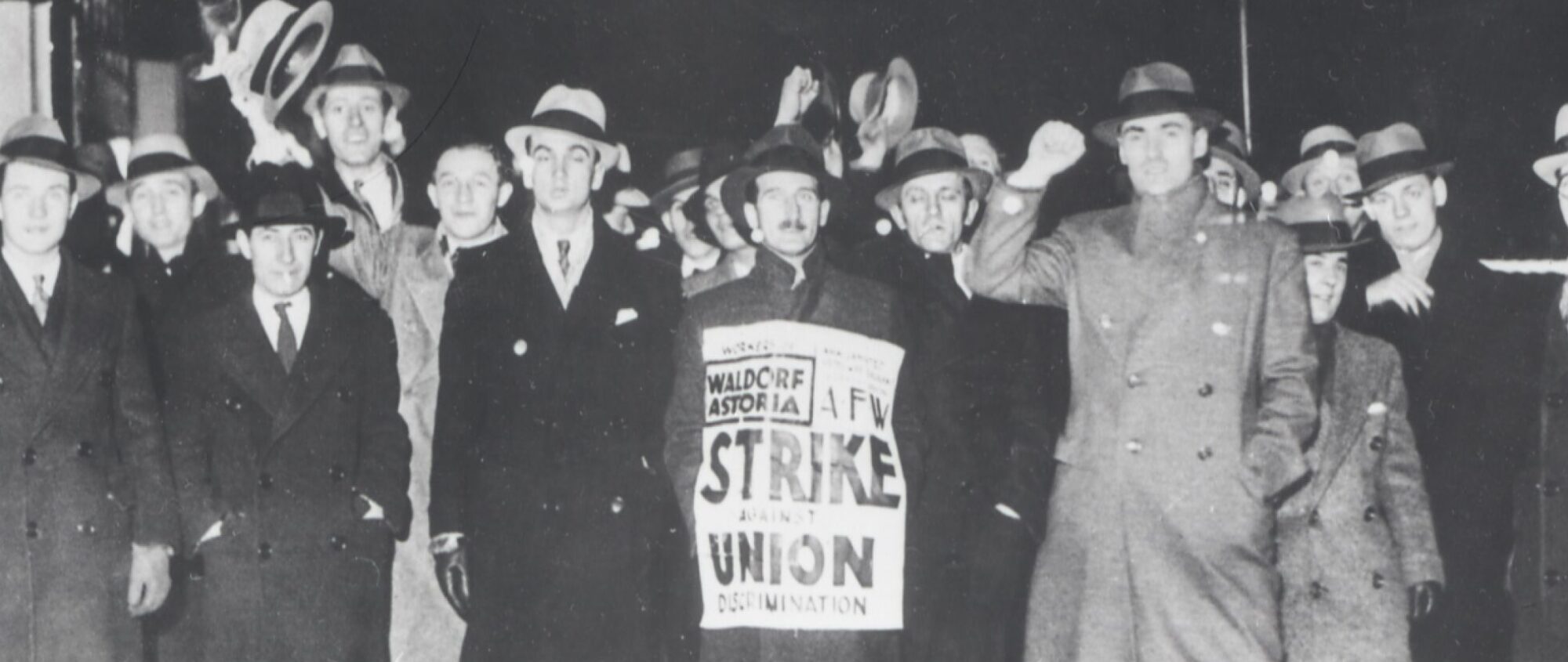
The first recorded strike for shorter hours—an unsuccessful effort by Philadelphia carpenters to win a ten-hour day—occurred during George Washington’s first term as president. The first May Day strike in 1886 infamously climaxed with a violent confrontation in Chicago’s Haymarket Square; its leaders were martyred on the gallows in a frame-up that caused an international sensation.
Prodded by unions, states and even the federal government enacted shorter-hours laws throughout the 19th century, but these were quickly rendered null and void. The 1905 Supreme Court case that symbolizes the pre–New Deal era when the courts vigorously resisted government regulation of private industry, Lochner v. New York, specifically overturned a law that limited the working week for bakers to 60 hours. The Court’s position was that the law interfered with workers’ “right” to “agree” to work longer hours. In 1902, the National Association of Manufacturers campaigned against a federal short-hours law for what it termed workers’ “right to work more than 480 minutes of a calendar day.”
Where laws combined with strikes and boycotts to briefly win a shorter working day, employers routinely reduced wages along with hours. The very concept of hourly wages is a by-product of 19th-century fights for “ten hours pay for eight hours work.” We still measure compensation in units of time because time and money are inextricably linked, and because employers have spent centuries chipping away at whatever gains in personal time workers have managed to win.
In 1938, the Fair Labor Standards Act purported to settle the hours question. It set a weekly maximum of 40 hours of work—not a daily maximum of eight or fewer that unions had long demanded—and made the main enforcement mechanism a requirement to pay time-and-a-half on overtime work. Far from being a stick to punish companies that didn’t hire enough employees to avoid having to pay the overtime premium, it proved more of a carrot to entice employees to overwork. At one of the first meetings of the newly merged AFL-CIO, a 1956 Conference on Shorter Hours, the first speaker to follow Federation President George Meany flatly declared, “Workers are eager to increase their income, not to work for fewer hours.”
Workers’ need to put in extra hours was exacerbated beginning in the 1970s, when wages lagged productivity and inflation ate whatever material gains workers had won through collective bargaining. The rising costs of employer-paid health insurance also held down wages, making a bad situation worse.
Our current system—pegging benefits like health care and retirement to individual jobs and employers—warps employers’ hiring incentives. Full-time jobs cost more to create because of the additional costs of benefits. Employers try to squeeze as much time as possible from these workers to make up for the higher costs. Conversely, other parts of the workforce are kept part-time and temporary to avoid paying any benefits at all.
Hence, if an employer wants 60 hours of work to be done, it has two choices. Split the job into two 30-ish-hour jobs with no benefits and unpredictable schedules, or create one full-time job with 20 hours of overtime to get the biggest bang for the buck for the additional cost of benefits.
Whether they work too much to live or not enough to survive, workers can suffer burnout and mental illness, reduced life expectancy, and a whole range of undesirable outcomes.
This current state of affairs is hardly the eight-hour day that the original May Day strikers fought for. American workers once made republican arguments that reducing the workday was essential for full participation in a democratic society. As well, an early theory of the short-hours movement was that the extra leisure would drive up consumer demand in ways that would more than make up for the initial loss of corporate profit. Giving people the money they’ve earned and the free time to spend it has usually been healthy for the economy.
But the hopes of the original May Day demonstrators haven’t come to pass. Average annual hours have steadily crept up in the United States since the 1970s. Today, Americans work an average of 1,780 hours a year, less than South Korea’s 2,024 but substantially more than Germany’s 1,356 (a difference of ten full-time weeks). And yet, German unemployment stands at 3.4 percent, lower than in the U.S., and the nation has similar levels of productivity and a substantially larger middle class. Why can’t we dream bigger?
Our modern problem of striking a meaningful work-life balance is so complex that there’s no one law that could reduce our lifetime obligation to work for wages. But we should start with wages, knowing that they can alleviate poverty, if not solve inequality. As corporations adopt a $15 minimum wage, it’s become clear it’s the bare minimum. By 2024, a single adult without children will need $31,200 ($15 at full-time hours annually) to maintain an adequate standard of living anywhere in the United States. If the wage is not indexed to inflation, it will immediately lose its value again. If 1968’s $1.50 minimum wage had kept up with inflation, it would be close to $12 today and nearly $21 if matched with growth in productivity.
The overtime protections in the Fair Labor Standards Act need to be rethought as well. Right now, salaried employees like social workers and administrative office staff can essentially work unlimited hours without overtime. Obama’s Department of Labor tried to fix this by raising the salary threshold for overtime eligibility from $23,660 to $47,476, but conservative states and business groups successfully sued to block it. Trump’s Labor Department recently lowered the proposed threshold to $35,000, leaving half the affected workers behind. Even when employers are required to pay overtime, it hardly acts as a deterrent to hazardous levels of work.
We should cast aside the 40-hour week altogether—it is an arbitrary and antiquated formula, leaving plenty of room for employers to impose 12-hour days, split shifts, “clopens,” and all kinds of on-call assignments that deprive a worker of the space to be fully human when she’s finally off the clock. Why not six-hour days! Four-day weeks? Would that be so horrible?
But even doubling or tripling overtime pay would not fully discourage employers from overworking their employees so long as the cost of health care is factored into payroll. One less-discussed benefit of Medicare for All is the freedom it would grant workers to walk away from jobs they hate and extra hours they’d rather not work. Employers would lose the perverse incentive to either underwork a large workforce or overwork a smaller one in order to avoid insurance obligations. Medicare for All would enable us, as a society, to spread the work around a bit more evenly.
Social Security is also an important component of striking a better work-life balance. For that reason, we need to expand its coverage to public-sector, domestic, and agricultural workers who don’t currently benefit from a guaranteed federal pension—funding that expansion by taxing incomes above $132,900. Lowering the retirement age would create a better work-life balance too.
Paid vacation and sick leave are also a part of the equation. We are dead last when it comes to guaranteed paid time off. Countries like South Korea, Germany, the United Kingdom, France, and Chile all guarantee employees over 30 days off, while the U.S. won’t even guarantee pay for federal holidays. New Jersey and Washington are among the states leading the way by offering some form of parental leave, largely through temporary-disability insurance. Ten states and D.C. now provide paid sick days. New York City is even considering a paid-vacation law. These policies make employment less unstable for millions of workers and provide needed rest without risking job loss or savings.
The federal government could build on these local efforts by creating a new supplemental Social Security paid-leave fund. Setting it up as an insurance fund everyone pays into helps ensure that workers actually use their earned time off. Those who don’t raise families could use the time off for other pursuits, like returning to school, or even as a bridge to earlier retirement.
In our age of inequality, we are constantly hustling for advantages to meet the spiraling cost of living. Our current work culture tells us if only we got more money or hours, maybe ends would magically meet. Experience, however, makes clear that for the vast majority of working Americans, this time-and-money trap falls short of creating the conditions for a good life. What really would help is more control over our time.
It’s time we cut work down to size.
[This article originally appeared at The American Prospect.]
Take This Bullshit Job and Pretend to Love It
The British economist Joan Robinson once remarked, “The misery of being exploited by capitalists is nothing compared to the misery of not being exploited at all.” What kind of misery is it, then, if your particular form of exploitation is being asked to do nothing particularly useful?
David Greaber explores this question in his thought-provoking and hilarious new book, Bullshit Jobs. Five years ago, he wrote an essay for the radical magazine Strike!, asking why people in the United States and England are not working the 15-hour weeks that John Maynard Keynes had predicted would be the result of technological advancement? In our post-scarcity society, he argued, only a tiny fraction of the population actually has to labor in order to provide for the material needs of all. “It’s as if someone were out there making up pointless jobs just for the sake of keeping us all working,” he wrote.
The essay went viral. Millions of people read it and thousands wrote him to vent about their own pointless jobs. Those first-person accounts enliven and flesh out Graeber’s book.
He breaks down these jobs into five major categories: Box-tickers, Duct tapers, Taskmasters, Flunkies, and Goons. While humorous, it’s also a well thought-out system of categorizing pointless work by the dynamics that create them. A Duct-taper, for instance, is hired because an existing employee (very likely a full-of-it supervisor) either skips or botches one essential part of his assignment and so an entire extra employee is hired to make sure that that one small task gets carried out. That task may be essential, but it hardly amounts to a full-time assignment.
A Box-ticker, on the other hand, exists mainly so an organization can claim it is doing something that it doesn’t actually take seriously. Much of this involves researching and compiling reports no one will read to comply with a regulation or to document progress on a mission or goal.
Flunkies, meanwhile, are employees hired purely to make their supervisor appear more important. A receptionist whose main function is to place phone calls for a middle manager just to say to the party on the other line, “Please hold for Mr. ____,” is a perfect example.
These bullshit jobs make up an astonishingly large portion of the global economy. Inspired by his initial essay, one U.K. poll found that 37 percent of respondents did not believe their job made “a meaningful contribution to the world.” A similar poll of Dutch workers found that 40 percent of workers didn’t think their jobs served a useful purpose.
Barraged by right-wing talking points, much of the public has come to believe that pointless, self-created bureaucracy is uniquely a public-sector malady. But Graeber found many times more private- than public-sector workers reaching out to him to complain—in detail—about their salaried jobs, which they said would make no discernable difference in the world if they quit and the posting was left vacant for several months (or years). Many of these were in financial and legal firms, where the bloat was by design. The purpose (for a law firm) might be to whittle away a chunk of a large class-action settlement on administrative expenses, or to make a manager seem more important by virtue of the number of employees reporting to him. Usually, it was some combination of the two.
The real difference between the public and private sectors isn’t—to borrow a line from Ghostbusters—that “in the private sector; they expect results.” Instead, Graeber finds, it’s that corporate firms expect every employee to actually show up each week for his or her 40-plus hours of “work” and to “look busy” while doing it.
Picture here the Seinfeld character George Constanza, who, after years of temp jobs and unemployment lands a cushy job in the New York Yankees’ back office. Well-paid and in delightful proximity to the heroes of his youth, he nevertheless suffers anxiety from the fact that he doesn’t understand what his job is supposed to be and nobody at work seems to be sweating him about assignments or deadlines. His stroke of brilliance is to furrow his brow and squint his eyes in a way that makes him “look busy” to his colleagues.
It’s funny in a sitcom but borderline tragic in real life. Why a bullshit job would be regarded as daily torture instead of a paid vacation might be confounding to anyone who hasn’t spent the lions’ share of her waking life pushing a boulder of Outlook calendar invites up a mountain of pointless conference calls on mute. As explanation, Graeber points to the early 20th century work of psychologist Karl Groos. Studying early childhood behavior, he noted infants’ delight at being the cause of an effect that they were able to repeat through their own actions—as well as their rage at being denied the continued ability to alter the world through their own actions. He called this “the pleasure at being the cause,” and time and research have shown that is elemental to human happiness.
Much of the “bullshitization” of white-collar work is purely accidental, but Graeber argues that capitalists couldn’t have designed a more effective pecking order of oppression if they’d tried. At the bottom, you have millions of workers striving to work longer hours and fighting for a couple more dollars an hour that might lift them out of literal poverty. In between the desperate lumpen and the de facto rulers of the world is a massive segment of the workforce who secretly suspect that maintaining a decent standard of living doesn’t correlate with useful or productive work (or, indeed, any work at all!). But challenging the system could imperil their relative comfort.
They are more likely to resent people whose jobs are easily explainable to their family and neighbors—but who nevertheless demand better wages and working conditions—than to make common cause with them.
Graeber points to autoworkers and teachers as workers who achieve a tangible degree of satisfaction from their work and who are frequent targets of the public’s ire for expecting that and decent wages. I think more of all those amateur chefs on Chopped, hoping to win a $10,000 purse in order to buy a food truck. How many thousands of people are living an essentially monastic lifestyle because they want to make a living feeding people? In a world filled with well-paying but meaningless work, or poorly-paid drudgery that a robot could (and may soon) do, is it any wonder that so many people yearn for a meaningful life spent cooking for people and watching them enjoy the literal fruits of their labor?
What I particularly love about Graeber’s book is how it contributes to the revival of the kind of labor lit that flourished in the 1970s. The last 40 years of globalization, automation, and the gutting of our labor laws has narrowed the focus of too many labor writers to questions of how workers can get enough hours at a high-enough minimum wage and with decent enough benefits to reverse an inexorable slide into poverty.
In the ‘70s, books like False Promises by Stanley Aronowitz or Barbara Garson’s All the Livelong Day, and especially Studs Terkel’s Working shined a light on the meaning that people struggle to find in their lives through their labor.
Interestingly, each of these books devoted some discussion to Lordstown, Ohio. That’s where General Motors had recently built a factory staffed with a bunch of hippies and Vietnam vets. These workers managed to turn the company’s pioneering “small car”—the Chevy Vega—into a notorious lemon through their protest campaign of wildcat strikes and sabotage. Despite generous and rapidly rising wages, the workers rejected not just the inhumane pace of the assembly line but also their alienation from any pleasure at being the cause of an actual car driving off at the end of production.
They wanted not just to slow down the pace of the assembly line, but to spend more time with each car as it was assembled. They wanted to experience more of the pleasure at being the cause.
Contrast all that with this juicy quote that Graeber digs up for what I don’t doubt was a sincere objection by President Obama to the push to expand Medicare for all:
Everybody who supports single-payer health care says, “Look at all this money we would be saving from insurance and paperwork.” That represents one million, two million, three million jobs [filled by] people who are working at Blue Cross Blue Shield or Kaiser or other places. What are we doing with them? Where are we employing them?
Absent a vivid socialist imagination, how can we justify all of these millions of office drones affording food, shelter, and clothing if we couldn’t make them spend 40-to-60 hours a week making every doctor and patient they deal with miserable and furious?
The closest contemporary cousin to Graeber’s book is Elizabeth Anderson’s Private Government, which questions why we surrender most of our constitutional rights at the boss’ doorstep and don’t even notice that we are doing it.
Like Graeber, she looks back at the value systems of the pre-industrial era and how they got twisted and confused during the revolutionary rise of capitalism and the nation-state. Anderson is a philosopher by training, and Graeber is an anthropologist—which highlights how important it is for labor studies to embrace its interdisciplinary nature.
Being an anarchist, Graeber is loath to suggest specific policy solutions. Still, he can’t help but talk about the policy that is most frequently advocated by the nerds who talk about the post-scarcity society: the universal basic income. Obviously, he sees value in decoupling the deservedness of food, shelter, and clothing from how one spends the majority of her waking hours. There simply isn’t enough useful work to go around for each of us to trade an hour for a loaf of bread.
The alternative progressive policy proposal—a federal commitment to full employment—is touted as more pragmatic and winnable. It’s a reasonable appeal to the god, mom, and apple-pie Calvinist work ethic. And, after all, there are a lot of roads and bridges that need to be rebuilt, a lot of child and elder care that should be compensated as the very real work it is, and well, who wouldn’t love to see a lot of WPA-style public artwork going up around the world? But, Bullshit Jobs should serve as a warning that a continued fidelity to the notion that one must work for one’s supper would likely condemn many of us to box-checking and duct-taping, as the machines take over and make most of us redundant.
[This article originally appeared at the American Prospect.]