Hershey’s Corporate Kiss-Off
This article was originally published in the January-February 2003 issue of “The Socialist.”
The recent announcement by the trust that operates the Hershey Industrial School that it was considering selling a large stake in the Hershey Foods Corporation set off waves of protest in the town of Hershey, PA, that eventually sunk the proposal. What kind of company town has effective veto power over its corporate benefactor’s business plans? Clearly, Hershey is a company town like know other.
To understand it better, one should place the town’s history in the context of the social reform movement of the turn of the century that formed alternative model communities founded with the aims of conquering the abject poverty and gross inequalities of the era’s great cities. The most identifiable are the socialist cooperatives like Robert Owen’s New Harmony, IN and Job Harriman’s New Llanos, CA, but socialists did not have a monopoly on alternative city building. The towns of Pullman, IL – best known now for the disastrous American Railway Union strike that turned Eugene Debs towards socialism – and Hershey, PA – best known now as the poor man’s Disneyworld – were themselves social experiments.
When the Pullman Sleeping Car Company needed to expand in 1880, initial plans had the company simply building its factory complex with the city of St. Louis. Paternalism and arrogance drove George Pullman to instead build a new city that he thought would be free of alcoholism, crime, poverty and labor strife. Ironically, it was his devotion to the city of his creation that brought on the strike of 1893. Had Pullman’s factory been located in St. Louis, he would no doubt have simply laid off thousands of employees during the national depression that was causing profits to plummet, but as it was the main employer and economic engine for a community he built and felt responsible for, the company instead embarked on a plan for work sharing. Wage rates were never cut, but weekly pay for employees was severely reduced because of reduced hours.
The conventional story of the strike is that Pullman reduced his employees’ pay without lowering rent on the company-owned homes where many employees lived. However, the vast majority of employees lived in two adjoining towns that had sprung up around Pullman, where they could own their own homes, as well as avoid the company’s overbearing meddling in their private lives and morality, and, anyway, the company never evicted a single employee during the resulting rent strike. The strike was more a result of pent-up frustration with the company’s dominant role in all aspects of life in Pullman.
The famous strike was eventually put down by the National Guard, and work resumed at Pullman’s factory, but the town was never the same. George Pullman died in 1897, resentful of his reputation as a tyrant and the reputation of his model town as an oppressive fiefdom. One year later, the Illinois Supreme Court ordered the company to sell all land not involved in the production at the factory, and the town shortly blended into the rest of Chicago, as an industrial slum.
The Sweetest Place on Earth
Amazingly, just a few years after Pullman died, another self-made businessman decided to build a model company town of his own. Friends warned Milton Hershey that the Pullman town had been a disaster and a black mark on the Pullman name, and that Pullman’s residents wouldn’t have elected George Pullman dogcatcher. “I know we’re taking chances,” replied Hershey, “but I won’t be a candidate for dog catcher: I don’t like dogs that much.”
When Milton Hershey decided to build his model town, the name “Hershey” was not yet synonymous with milk chocolate. Indeed, in 1900 the world did not yet know milk chocolate. Chocolate was a luxurious treat for the wealthy. Milton Hershey had made a fortune with a caramel business, which he sold for the unprecedented sum of one million dollars in 1900. Although he retained rights to a small chocolate subsidiary, it specialized in novelty chocolates and was something of a hobby for Hershey, who simply planned to spend his wealth and the rest of his life touring the world with his wife.
For some reason, Hershey abandoned the idea of conspicuous consumption and opulent travel and, like George Pullman, became interested in solving the problems of modern industrial life. Thus, Milton Hershey started the Hershey Chocolate Co. to support his town, not vice versa. Hershey worked on a formula for milk chocolate that could be mass-produced, to provide his town with sustainable industry.
Ground broke on the new town in 1903, near its own source of dairy farms in Pennsylvania Dutch land. The Philadelphia and Reading Railroad served Hershey, at the request of Milton Hershey. Hershey also built a trolley system.
At the center of town was a 150 acre park, featuring a band shell, golf course and a zoo. Hershey continued to add attractions, and by 1913, the park was receiving 100,000 visitors a year, giving Hershey a second industry: tourism. Hershey built banks, department stores and public schools. In addition, he built training schools like the Hershey Industrial School, a generous boarding school for orphans.
In fact, when Hershey’s wife died in 1915 he donated his entire estate – 30 years before his own death – to the Milton Hershey School Trust, which operated the Hershey Industrial School. This strange, quiet act of philanthropy had the peculiar effect of creating a corporate giant that is to this day owned by an orphanage. The result is that the town of Hershey and the Hershey Foods Corp. are more closely tied than one might believe possible in this era of free trade.
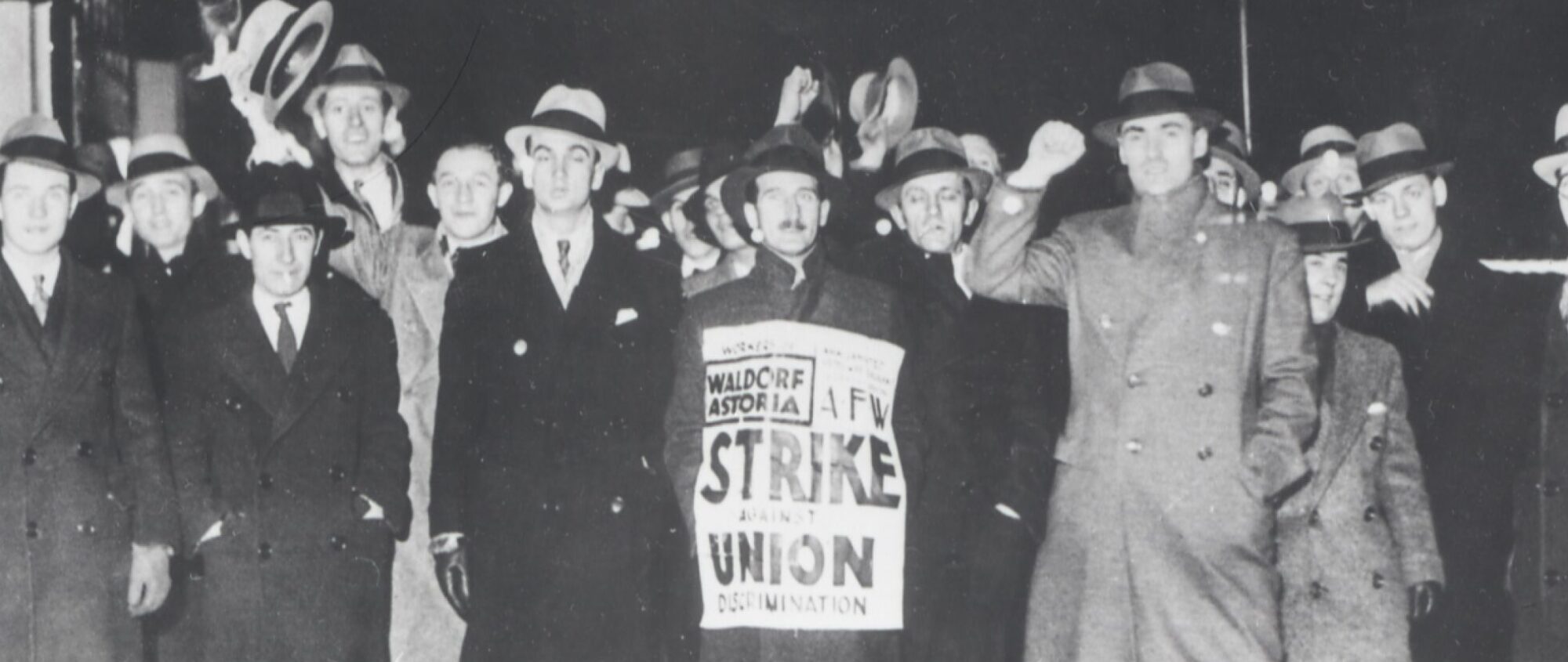
Hershey, PA is no stranger to labor strife, however. In a case of history repeating itself, Hershey was the target of a strike by a radical labor union – this time the CIO – during a depression – this time the Great Depression. Despite the fact that Hershey laid off no workers and made no wage cuts, Hershey, PA was caught up in the wave of sit down strikes and Communist agitation. In April of 1937, 600 workers took control of the factory for five days. The strike was broken not by the National Guard, but by angry farmers (who were losing 800,000 pounds of milk a day) and workers loyal to the company, who broke into the factory and beat-up and forcibly removed the strikers. Hershey eventually signed a contract with the more conservative AFL.
Despite this black mark, the town of Hershey, PA is a modest success. Though by no means the utopia Hershey envisioned, the town exists today as a successful tourist destination and the chocolate factory continues pumping out product, and providing the town with a base for industrial jobs.
It may be easy for a reader who is normally critical of the role of corporations in public life to romanticize the example of Hershey, PA. Certainly, the relationship between the Hershey Company and the town of Hershey is an admirable one when compared to Flint, MI and General Motors. Also, since the established rules of the new global economy eschew corporate-community ties, we can be pretty sure that experiments like these are a thing of the past.
In fact, it was the rule of law that nearly caused the Hershey School to sell the company this past summer. The rules of “fiduciary responsibility” that have bedeviled stockholders’ “corporate responsibility” efforts caused Pennsylvania Attorney General, Mike Fisher, to pressure the trust to diversify its holdings, the majority of which are Hershey stock. It was enough to have business observers, like the Wall Street Journal, salivating over the merger possibilities, as well as the influx of Hershey Trust cash in a soft market. It also came at a time that Hershey workers were fighting out the longest strike in company history, over proposed health plan cutbacks, proposed by the first non-Hershey resident CEO in the company’s history. Whatever respite Hershey workers and residents have won seems likely to be short-lived.
We Are Improving to Serve You Better
I’m in the process of switching the blarg from Blosxom software to WordPress, which might involve a radical overhaul of the ancient content on the dot org. To prepare, just in case, I’m posting some older writing on the blarg, so that it can be archived here, instead of as dusty old html.
First up is my oft-reproduced Marxist analysis of the film “Willy Wonka and the Chocolate Factory.” The article began life as a term paper for my Labor Studies 101 course when I was a wee little snot (I got an A). It was shortly thereafter published in the awesome zine, Lumpen. David Raffin has also published it in Vision?Nary!
Please excuse our appearance during renovations. We are still open to the public!
Health Care’s “Death Spiral”
In “Uninsured in America,” Susan Starr Sered and Rushika Fernandopulle attempt to find out “where the bodies are buried” in our health care system where over 45 million people have no insurance. The book is a patchwork of profiles of people who got sick at times when they lacked insurance and the often devastating effects this had on their lives. The authors, who describe this phenomenon as the “death spiral,” don’t find so many bodies buried (although they do find many in jails or on the street) but they do find health problems that are allowed to become critical before state assistance will kick in and doctors actually pay attention, and emergency rooms used as primary care resulting in crippling debts.
Without getting bogged down in dry facts and figures, the authors provide a pretty good understanding of how the number of uninsured Americans hides how many Americans are functionally uninsured, covered by plans that have expensive premiums, deductibles and co-pays, that refuse to pay for the very “pre-existing conditions” that people most need health care for and slipping in and out of the patchwork system of Medicaid, charity, clinics and emergency rooms.
The book reminds me of an experience working for the health care workers union, doing community organizing among poor souls on Long Island whose medical debts were referred to collection agencies. Although the non-profit hospital where they went to the emergency room was required by law to provide a certain amount of charity care, these patients were never informed of the option to apply for the charity. Instead they were treated, charged tens of thousands of dollars that they could not possibly afford and had their lives turned into nightmares of bill collectors, bankruptcy and foreclosure. One family actually had good health insurance won through a union contract, but a bureaucratic error at the hospital resulted in the patient – not the insurance company – being billed. The insurance company and the hospital fought, refusing to admit error, and the hospital simply referred the matter to a collection agency. The rest of the people had no insurance. A surprising number of them had children with asthma who had bad attacks that required a visit to the emergency room. Just like that, the family became poor.
This patchwork system results in poor health care for all of us, I think. I hate going to the doctor with any kind of health complaint. I never get any kind of satisfying diagnosis. Usually, the doctor just guesses at a diagnosis and prescribes some kind of medication, without running any tests, and there’s no follow-up. I think the paperwork and bureaucracy is too much of a hassle. Fortunately for me, if my doctors miss something big, the care will be paid for by insurance so I won’t have to wait until I get so poor and so near-death that the state will finally pick up the bill, like the people profiled in “Uninsured in America.” Of course, why would I really want to push for tests that would confirm a medical condition, if that will only be used against me in seeking insurance in the future?
Why No National Health Care?
The United States has the best health care that money can buy, provided one has the money to buy it. Jill Quadagno’s “One Nation Uninsured” answers the question “Why the U.S. has no national health insurance.” It’s a brisk, engaging read that neatly summarizes how 90 years of failed reform efforts have entrenched the powerful interests that profit from the system.
The most prominent early opponents of a national health service were the doctors themselves. Their lobby, the American Medical Association, fought against “socialized medicine” out of fear that it would lead doctors to lose their sovereignty to bureaucrats basing decisions on budgetary needs rather than medical needs. Allied with southern politicians who feared that a federal health system would force racial integration of hospitals, these forces successfully kept national health care out of Roosevelt’s original Social Security legislation. They favored market solutions like Blue Cross and commercial insurance. A new business was created, resulting in a more powerful lobby.
The trade union leaders of the time, many of whom were social democratic in their outlook, reluctantly shifted their efforts at creating a social safety net to the bargaining table, winning employer-sponsored health care plans. Some unions – notably Sidney Hillman’s Amalgamated Clothing Workers – created their own networks of health care clinics, socialized medicine in miniature. Wartime government policies that encouraged fringe benefits over wage increases greatly expanded the private welfare state so that by the 1950’s, most large employers (including non-union firms that aimed to remain non-union) provided health care benefits.
Trade unions continued to push for a government solution to health care, but by the 1960’s they narrowed their focus to the proverbial “camel’s nose under the tent,” health insurance for the nation’s elderly. The Medicare program that the coalition of labor and seniors won had several unintended consequences. One was that with senior citizens covered through the program, and most working families fully covered by an employer’s plan, few voters clamored for a universal national health care system for the next few decades. Another consequence, happily, was the racial integration of most hospitals, under threat of being denied Medicare funding.
A regrettable consequence of Medicare was rampant inflation of cost of health care. Doctors and hospitals provided comprehensive care for senior citizens, ordering tests, procedures and drugs that they might not have before there was guaranteed funding, which was a boon not only to the health of senior citizens but to the corporate bottom line of the for-profit hospitals and insurance companies that joined the market for health care services. The cost of Medicare skyrocketed, until government efforts to control costs caused insurance companies to simply pass on the costs to employers in the form of higher premiums for their employees. Companies responded in turn by cutting benefits, introducing co-pays and turning to health maintenance organizations to control costs by denying care. The doctors’ worst fear, losing sovereignty over medical decisions, was realized through the insurance companies that they were responsible for creating.
This brings us to our current circle of hell, where an employer’s threat to cut benefits leaves many unions close to helpless in contract negotiations, where people with the dreaded “pre-existing condition” are denied meaningful coverage and where the existence (or non-existence) of national health care or employer-sponsored insurance goes a long way towards determining a company’s competitiveness in the global economy.
This January, I’ll be taking an elective class with Dean Robinson that will be exploring the United States’ lack of a national health service and its impact on our health, wealth and democracy. Quadagno’s “One Nation Uninsured” is the first book assigned. Others are Kawachi and Kennedy’s “Health of Nations: Why Inequality Is harmful to Your Health” and Sered and Fernandopulle’s “Uninsured in America.” For my paper, I will be taking a look at some trade union health clinics, particularly the Amalgamated’s (now UNITE HERE) and the NY Hotel Trades Council’s, which was inspired by Hillman’s example. These socialized medicine-in-miniature not only provide comprehensive health services, but they keep costs so low that employers actually offer up concessions in order to take part.
The lesson here, I think, is that while we might succeed in creating a single-payer health care system like Canada’s (particularly as health care becomes more of a crisis), inflation and price-gouging will be crippling until we take the profit out of the system and nationalize health care services to serve the interests of the people, not the corporations.