Look for My Union Label
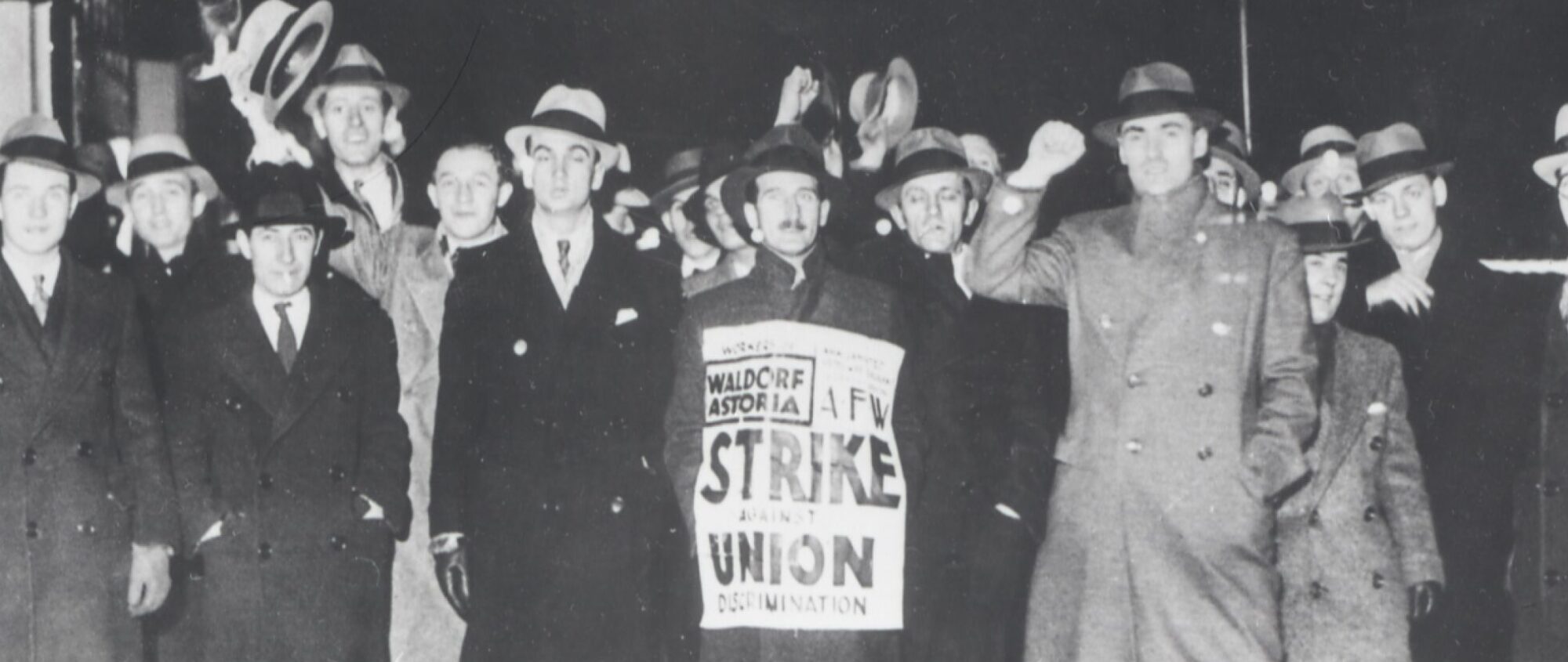
I’ve finally rejoined the National Writers Union (UAW Local 1181), the freelancers union. I had been a member when I was the editor of the Five Borough Institute’s newsletter, mainly because we wanted to have a bug on the masthead. I let my membership lapse during my long stint of unemployment, even though I had begun to write regularly for this blarg.
I realize I should be paying lip service to this supposed new media revolution, but truthfully, it’s hard to think of myself as a “Writer” because of a silly blog. I want to be in print. I’ve made sporadic attempts at submitting op-eds to local newspapers. Unfortunately, most of the community weeklies don’t publish opinion pieces. Even the one paper where I was briefly hired and quickly “dooced” doesn’t want actual opinions in their op-eds. I’m hoping that my renewed NWU membership will spur me on to try more seriously to get in print, even if that pesky “full-time union organizer / part-time graduate student” thing gets in the way.
The Champions of “Democracy”
The changed political landscape affords the labor movement opportunities to change laws that make us weaker. These opportunities afford right-wing politicians and management consultants new opportunities to couch their attacks on workers’ collective rights to organize in terms of “democracy.” We have to counter this rhetoric before it becomes standard Newspeak.
First up, Maryland’s House Republican leader Anthony O’Donnell attacking a bill for agency fee for state employee unions: “Forcing people to fund a service that they don’t desire to have is patently undemocratic.” To Mr. O’Donnell, I say, I don’t support the war in Iraq – or indeed any military spending – as a “service.” Am I free, in the name of democracy, to evade my taxes? Employees who are covered by a collective bargaining agreement benefit from the wages, benefits and protections that the union has won, and have available to them a grievance machinery in which the union is required to expend resources to represent all employees. A union is a democratic organization – a government – that all the employees in the bargaining unit belong to, and can take part in. Free riders who don’t pay their dues are benefitting from representation without taxation, a costly drain on union finances that holds us back from further organizing.
Next up, Dick Cheney, announcing the President’s intention to veto the Employee Free Choice Act, declared, “It’s important for everyone in the debate to remember that secret ballots protect workers from intimidation and ensure the integrity of the process.” It’s hard to know where to begin with this one. A comment on the Bush administrations track record on the sanctity of the ballot? How about the administration’s suspension of collective bargaining rights for Homeland Security employees? Or maybe the Bush-appointed NLRB’s decision to suspend union authorization elections for up to eight million workers who have neither the authority not compensation of management as exempt “supervisors.” No, let’s skip the ad hominems and debate the words. Where does intimidation arise in the organizing process? Is it from co-workers appealing to each other’s sense of solidarity to join together, or is it the reign of terror that management typically launches in anticipation of an NLRB election? As our friends at CEPR have pointed out, one in five union activists can expect to be fired during an organizing campaign. The remainder can have their jobs threatened, face “predictions” of plant closure or layoffs and generally have their lives made miserable while waiting for an election. Most of these actions – particularly terminations – are illegal, but the enforcement is so lax and the penalties so slight (a wrongfully terminated employee can expect, on average, $2000 in back pay from the employer) that most employers view the costs as well worth it to keep a union out.
Most unions file for authorization with 60 to 70 percent voting yes by signing union cards. The NLRB conducts a superfluous second election that provides management with a window of opportunity to conduct a reign of terror against its employees. Our oh-so-democratic proponents of the secret ballot while likely claim that this campaign merely provides “the other side” a chance to introduce new facts into the “debate.” The truth is the only new “fact” that management introduces into a union election campaign is the fact that a worker who supports the union is in danger of losing his or her job. It is precisely this kind of intimidation that the Employee Free Choice act will put an end to by allowing employees to vote just once to form a union, in an atmosphere free of intimidation.
The Two Barbaras
What kind of readers find Barbara Ehrenreich’s recent books remotely edifying? How far up their own asses are these people? I have to admit that I’ve yet to read the book in which she passes for working poor, although I did read her earlier piece in Harper’s magazine that served as a teaser. The fact that some of the lowest-paid service workers have to live in motels because they can’t afford a full month’s rent on an apartment was the only revelation for me (in New York, even our motels are too expensive, so people cram dozens of bodies in small apartments). Do you want to know how the poor live? Talk to your janitor, waitress or telemarketer. The paucity of actual interviews in Ehrenreich’s books saps the story of emotional resonance and dulls her political points.
This tendency is exacerbated in “Bait and Switch,” in which our supposed heroine poses as a white collar corporate job seeker. That corporate downsizing can cause the lives of the white-collar unemployed to spiral right out of the middle class and out of control is, indeed, a story worth telling. But Barbara Ehrenreich doesn’t tell it here. Instead, by going undercover as a PR executive on the job market seeking to enter the corporate world she was never a part of, Ehrenreich gives us 237 pages of a totally misguided job hunt. Parasitic image consultants and job hunt advisors sap her of thousands of dollars over the course of a fruitless year-long search. That says more about her poor choices and lack of support network as a corporate novice. Throughout, she trips over desperate, embittered job seekers – former corporate success stories who were thrown overboard by their employers in middle age – whose plight and occasionally populist gripes about modern capitalism who would be far more fascinating subject matter, but Ehrenreich’s self-indulgent format does not allow for interviews with them.
For some reason, Barbara Ehrenreich is inextricably linked in my mind with fellow socialist and author Barbara Garson. Like Ehrenreich, Garson is a humorist who attempts to grapple with major economic issues in an accessible manner. I recently re-read one of her earliest books, “All the Livelong Day,” which I am including in the theoretical syllabus of the Labor Studies 101 class I’d like to teach one day. Spurred on by curiosity about Big Concepts like Taylorism and “alienation of labor,” Garson innocently asks, “what about the workers?”
While she, too, poses as a worker in a 9 to 5 job to write about the effects of mind-numbing routine on her psyche, this is merely one short chapter. The rest of the book is full of wonderful interviews with workers (Barbara G. is a playwright first and has a wonderful ear for dialogue and an eye for detail) about how they view themselves and their jobs and how they make the time go by. These details – like the woman who daydreams about sex while pulling red meat from white at the Bumble Bee tuna factory or the office pool secretary who amuses herself by typing in a rhythm with her coworkers – really make the text come alive and provoke the reader to think about his or her own private thoughts at work, all while illuminating fairly dense economic theory. Her books are far more deserving of best-seller status, and worth your attention.
Another Terrifying Labor Statistic
The Center for Economic and Policy Research has released a report that finds that one in five union activists can expect to be fired during an organizing campaign under George Bush’s watch. Overall, a pro-union worker had a 1.4 percent chance of being illegally fired for his sympathies in 2005. An organizer’s gut reaction to authors John Schmitt and Ben Zipperer’s paper might well be, “Oh, great, just what my organizing committee needs to hear!” The fact is that workers already know that organizing is risky (and organizers don’t suger-coat the risk).
Combined with threatened and actual plant closures, terminations and employer animus are the greatest reasons why half of all union representation elections lose and so many more campaigns never even come to election as activists are fired as a chilling example to their coworkers not to step out of line. The report’s numbers are based on cases where the National Labor Relations Board found a termination to be illegally motivated by anti-union animus and ordered that the employee be reinstated with back pay. This remedy is hardly punitive, since the boss is not fined or jailed for willfully violating the law, and, indeed, the back-pay that he must make up are the wages he would have paid anyway minus any other wages that the employee earned from other employers in the meantime, which at an average of $2,749 per fired worker is a huge discount if the firing successfully discourages the rest of the workers from pursuing their organizing campaign.
The authors utilize NLRB data for their report, which ignores a world of activity beyond an increasingly archaic and anti-union process. Public sector employees, who are governed by state laws, are far less likely to face termination for their union activism, a fact that Kate Bronfenbrenner and Tom Juravitch cited in an earlier paper as a reason for the higher win percentage for unions in public versus private sector campaigns. And many innovative unions are bypassing the NLRB election procedure for pressure campaigns leading to card check recognition. Union activists are probably less likely to be terminated during such a campaign, but it’s impossible to gather numbers. Instead, the authors estimate the number of workers organized through such procedures and add them to the universe of their study, which produces a very conservative figure for the likelihood of a pro-union worker to be fired.
Schmitt and Zipperer perhaps should have ignored these cases entirely and focused on the NLRB process. What their paper would be then is yet another convincing argument that the National Labor Relations Act is broken; that, on the whole, it serves management’s interests and provides a legal roadmap for a campaign of terror to beat back most union organizing campaigns, and, as such, is in desperate need of reform or repeal.
Labor law reform is on the agenda, with the Democrats newly in control of Congress, although mostly as a wedge issue for the coming presidential contest since Bush is likely to veto anything that the Congress passes on labor (save, perhaps, for a narrow tweaking in response to Kentucky River). The prospect of a Democratic presidency coupled with the Democratic Congress, absent a groundswell of political pressure, should not inspire too much optimism. After all, labor law reform was on the agenda the last time the Democrats controlled Washington (and the situation was, in some ways, worse – a worker was more likely to be fired for union activity during the Reagan years), but two years of studies and commissions produced nothing.