The High Cost of Health Care (For Cats)
The high cost of health care is a problem for more than just us monkeys. The price of veterinary services has skyrocketed faster than inflation, too. I had the opportunity to buy pet insurance through my union, but declined. Pet insurance is for little old ladies who order chemo-therapy for their hobbled, mangy 19-year-old cats, isn’t?
Well, about two months ago, my cat, the duck, began a campaign of biological warfare in protest of my longer hours at work on a campaign in New Jersey (or so I thought). I took her to the vet. Urine tests were inconclusive, but antibiotics were prescribed anyway, in case it was a urinary tract infection. Oh, and duck needed booster vaccinations. It’s the law, the vet said. The bill was eighty bucks, but that didn’t seem too bad a price to pay to get my cat to stop peeing on every piece of furniture I owned.
The duck would foam at the mouth when the cold white goo was injected in her mouth, and she proceeded to go on a three day hunger strike. Back at the vet’s office, she was admitted for overnight observation and more tests, also inconclusive. This time the diagnosis was behavioral, and the doctor ordered anti-depressents, which included options for kitty Prozac and kitty lithium. “They’re actually the same as human Prozac and lithium,” the vet helpfully explained, in case I might want to dip into the supply myself after seeing the bill. Another ninety dollars.
This bought thirty days of relief. As soon as the medication was out of her system, though, she peed on my couch. This time I found blood in her urine. Back to the vet for another overnight stay, more tests and another hundred and something dollars in expenses. The tests, an X-Ray and MRI, found a stone in her bladder. Surgery would be required. That was estimated to cost seven hundred bucks.
Of course, there were options when I brought her back for the surgery. Laser surgery would reduce bleeding and improve recovery time. That would be another fifty dollars. An IV catheter was strongly recommended for older cats (Oh, yes. I forgot to mention. duck is an older cat. When we rescued her from the mean streets of Valley Stream, LI, she was estimated by that vet to be two years old. When I brought her in to the local clinic for the first time, the vet said, “If I was being charitable, I would say this cat is six years old. This is a middle-aged cat.”). The IV and fluids would cost another seventy bucks. What the hell. It’s kinda like throwing in options on a new car. You’re already paying so much, what does it matter now?
It’s a good thing I’m in line for a promotion at work. All the money will go directly to the duck. Back at home, the couch is covered in garbage bags because the stitches on her bladder will itch and irritate and may still cause “accidents” for the next ten days. She also needs to take antibiotics, which, helpfully, are pills this time. She gobbles them and her pink crazy pills like a good little pill popper. Her front left leg is shaved like a poodle, as is a good deal of belly, revealing a ridiculous fleshy paunch with a zipper of stitches in the center. She’s wearing a cone around her neck to keep her from chewing out the stitches. She looks more annoyed than usual, and her equilibrium is totally thrown off. She does a ridiculous high step so she can see her paws and be sure they’re walking in the right direction. She keep bumping and snagging on doorways, as she still slinks and rubs against them before entering a room.

With great timing, I’m finally being sent back to New Orleans on Monday. A sucker, er, sweet friend has volunteered to duck-sit and handle medical chores. I need to figure out a living situation for me and the duck if the promotion I get is a traveling organizer position with the national union. This has involved calling ex-girlfriends to see if they would be foster cat moms while I sell my apartment in order to trade up to a 2-bedroom with space for a cat-loving roommate.
Re-reading this article, it occurs to me that I have become the little old lady who orders chemo for her geriatric cat.
It’s the Hair, Not the Ho
Not to belabor the point, but Barbara Ehrenreich doesn’t get it. Writing in the Nation (online edition), she declares, “Of course it’s the ho, not the hair, part of Imus’s comment that hurts.” Actually, it is the hair that hurts.
Once again, Barbara can’t see past her white, middle class nose to define an issue for what it is. In this case, it’s a blatant case of racism as Imus was contrasting the looks of the Rutgers players with the cute, blonde Lady Volunteers. You don’t have to be black to know how culturally sensitive hair is. Just look at the beauty products that are advertised to black women – the hair relaxers, the weaves, the weird blonde dye – all designed to satisfy white standards of beauty. Look at the handful of books and poems by black artists that we are assigned in high school (out of some token notion of diversity, so that we can look past our white noses). There’s Langston Hughes’ “high yaller” girl. There’s Lorraine Hansberry’s Beneatha Younger, whose brother scorns the afro that she grows. There’s Toni Morrison’s Soaphead Church, who prizes his mixed blood and “good hair” and takes pity on an “ugly” (and delusional) black girl who wants to look more white.
Hell, just take that term “good hair.” Google it and you will see the tortured relationship that black women have with their natural kinky hair. You’ll find salons and hair products to get rid of the nappiness. You’ll find African-American chick-lit about “moving on up.” You’ll find websites dedicated to empowering black women. Somewhere along the way, you’ll find a far more articulate essay on this subject by Malena Amusa on hair weaves and black women’s self image.
The fact that Imus could be so casually derogatory about something so sensitive to black people is what makes his remarks so offensive. It’s the racism that gave this controversy legs.
Pride of the Nappy-Headed Hoes
There was an enormous protest today on the traditional women’s college campus of Rutgers University over Don Imus. Imus, of course, disparaged the University’s second place NCAA women’s basketball team in crudely racist and demeaning terms about two weeks ago. The controversy, which has raged across the country and which threatens Imus’ career, started out with very little notice here: a “dart” to Imus in the Daily Targum newspaper’s traditional “Darts and Laurels” Friday editorial. Today’s rally, however, seemed to attract the majority of the student body of Cook and Douglas Colleges, and cleared out the staff from most of the offices.
The women’s basketball team’s success in the Final Four tournament united the women and the bleeding hearts of Rutgers University in a way that the comparable success of the school’s football team – which came at the expense of budget cuts to academic programs and less popular sports – never could. Such feminist support was underscored by the signs that protesters carried, which read “Rutgers Women R Strong Women” (Imus described the team as “rough-looking” tattooed women and “nappy-headed hoes” and expressed a preference for the “cute” Lady Volunteers of Tennessee). But Imus’ racism – no matter how much he insists he is a “good person” – is clear and unmistakable. Kinky hair and eurocentric standards of beauty are enormously sensitive topics and the rooting for “white” over “black” is the very definition of racism. And yet, this racism bubbled up and spilled forth so effortlessly, coming from the same dark pit (more like a shallow ditch) as Michael “Kramer” Richards’ “joke” about lynching niggers who dare to talk through his set, or as your crazy uncle’s “jokes” about black moms and velcro.
I’m inclined to agree with the protesters (most famously Al Sharpton and Jesse Jackson) who complain that Imus’ apology rings hollow, and call for his termination. Our media and politics have coarsened to such a point that a great number of shock jocks and pundits profit by saying outrageously insulting and offensive things, and if any of them result in a controversy that proves dangerous to their careers, they quickly apologize and claim it was a joke. But what was the joke here? That Don Imus doesn’t really think the Lady Volunteers were cute? That the Rutgers Scarlet Knights are actually blonde, light-skinned and unmarked by tattoos?
There was no joke. Just mean-spirited taunting, the kind that is casually tossed around in talk media. Examples should be made. Don Imus made the poor choice to elect himself to serve as that example.
Comrades in the Library
The Times has an article on one of my favorite places in the world, the Tamiment Institute archives at NYU, which has recently acquired a huge chunk of the Communist Party USA’s files. The CP should really be applauded for its openness and willingness to view its past truly as history. I have seen some of the neato gems of these files – such as Seeger’s handwritten lyrics to “Turn! Turn! Turn!” – on display while doing my own research at the library.
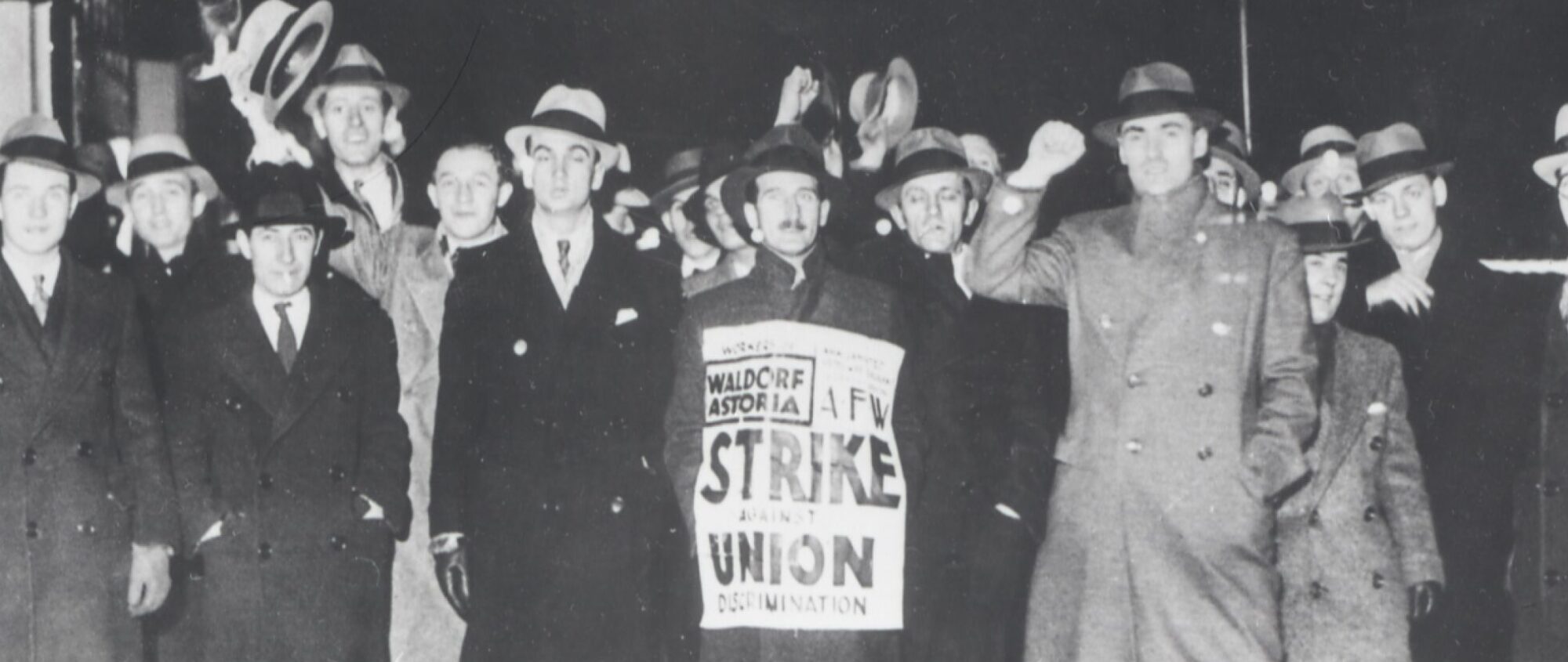
It was there that I recently found Michael Obermeier’s letter to Jay Rubin. The letter would have provided much-needed pathos to the term paper that I ultimately wrote about the Communists who founded New York’s Hotel Employees union, who were ultimately thrown out early in the Cold War. The letter was meticulously misfiled away with Rubin’s correspondence from the 1970’s (he must have kept the letter close at hand until the end of his tenure). Most of the union’s files are archived at Tamiment, so I’ve spent much time there.
I’ve continued to write about the union in term papers on its organizing strategy, its health care politics and its collective bargaining. I will ultimately flesh out my earlier term paper on the Communist influence and betrayal in Local 6 in my Masters thesis, which I hope to have published (which is why I have hesitated to post that earlier paper on this site).
In the meantime, I gather as much material as I can. I FOIA FBI and INS files, seek out sister unions’ files and living relatives of the main players. The Communist Party’s archives are quite promising for my research, although the most explosive material was likely shipped over to the Soviet Union in the late 1940’s. It exists today at the Library of Congress and at Tamiment as a microfiche reproduction of the source material in Moscow. The files are indexed in Russian, so I will likely need some translation assistance, tovarich.