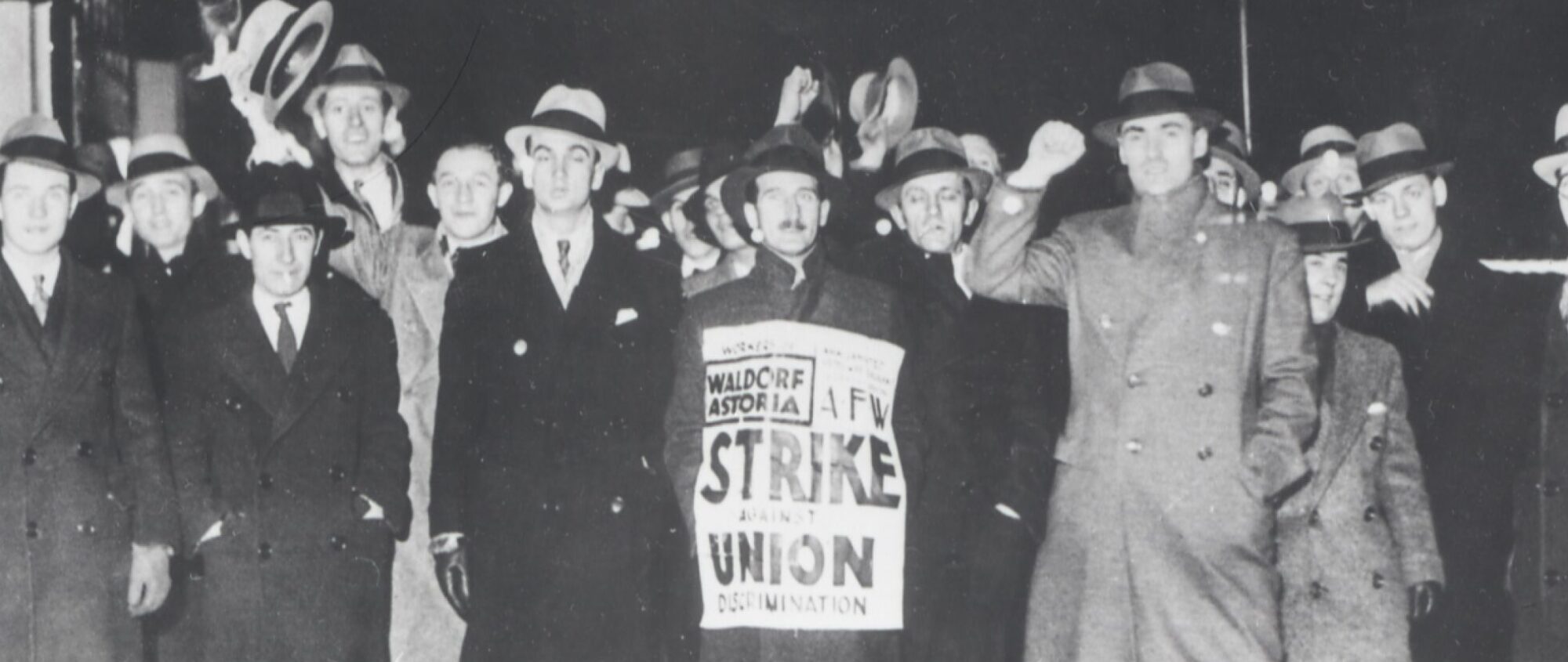
Portrait of a Charming Man
It’s hardly unusual to find a glowing hagiography of a corporate CEO in the pages of a major newspaper. I’m not, per se, opposed to feting J.W. Marriott. If you can get past the creepy fact that he’s a high elder of the Mormon church, he’s just a charming old man who values family, tells hokey jokes and makes a point of being personally courteous to his workers. However, when the Washington Post goes so far as to twist the words of a leader of the hotel employees union to make the CEO of one of the most viciously anti-union companies in the country sound like a good boss, well, that’s when I get mad.
The Marriott corporation runs an anti-union operation as pervasive and sophisticated as Wal-Mart’s. First-line managers are trained to call the corporation’s central union-busting office at the slightest sign of discontent. Corporate’s union busters fly in and do the usual mix of firings, captive audience and one-on-one meetings, and maybe even a slight raise in wages – all in order to keep the status quo of “on-call” employment with no job protection.
The author of the piece, Michael Rosenwald, interviewed the hotel division president of UNITE HERE, John Wilhelm, for the piece. Wilhelm presumably used the opportunity to speak at length about Marriott’s anti-union track record – such as the fact that only ten percent of its operations are unionized compared to better than 30% of Hilton and Starwoods, or the briefly-alluded-to 20 year fight to unionize San Francisco’s flagship Marriott hotel – but the author shallowly focused on the few positive things that Wilhelm could say about J.W. Marriott.
Like, for instance, his common man touch when dealing with employees on a personal basis. Okay, so the man introduces himself and engages in chit chat with the bellmen and doormen when staying at one of his hotels. Well, that’s nice…I guess. But is this only notable because most corporate suits act like total dickheads around the “hired help?” How about the doozy that in the three cities where UNITE HERE has managed to make dealing with the union a cost of doing business that Marriott “live[s] up to the terms of the contracts?” When does living up to the legally enforceable contracts you have made become laudable, or even notable? Only in the context of a company that breaks the law with impunity when resisting its workers’ rights to organize and improve the job.
The Washington Post owes readers a complete picture of Marriott’s union-busting human resources policies, or else it owes us their traditional silence on wrong-doing when praising a charming elder statesman.
Back In the Line
At first blush, Thursday’s story in the Times Metro section that disgraced former Central Labor Labor Council President Brian McLaughlin has returned to work as a rank and file electrician has a certain poetry to it. McLaughlin is charged with stealing from the New York State legislature where he served as an Assemblyman, from his own re-election campaign, from his home local in the Electrician’s union, from the Central Labor Council and, most ignominiously, from a union sponsored little league – over two million dollars in total. The evidence is damnable.
That the dapper chief could brush off years of high living and the shame of his fall from grace, and return to work alongside the union brothers he has let down, at a job that is very physically demanding when most men his age are considering retirement is almost, well, admirable.
Damn his eyes. I can’t help but feel used all over again. Surely he returned to the trades and had the story leaked to Steven Greenhouse of the Times in an attempt to co-author the last chapter of his story before he goes down the river. I’d like to believe that McLaughlin waited his turn in the union’s hiring hall roll call like any other brother, but I ain’t making the mistake of taking his honesty for granted ever again.
Most troubling is McLaughlin’s claim that he is working because he needs the money. Even before the graft, McLaughlin collected sizable multiple incomes from the Assembly, Local 3, the CLC and other assorted bodies. The tendency of labor leaders to collect multiple salaries from their various affiliates is a well-known tactic to obscure exactly how large their salaries can get, and McLaughlin was already a bit of a joke in the movement for how baldly he sought out additional salaries. In fact, his ability to clear over a quarter million dollars a year, “ethically” (if not particularly nobly or selflessly) is partly what led me to conclude that the man was probably honest. After all, who would need more money than what he was pulling down “on the books?” And where did it all go?
I worry that Brian McLaughlin has, as they say, debts no honest man can pay and that his scandal is only just beginning.
Here’s To Dad
I mulled over an all-encompassing Theory of Everything as I was squeezing a lemon over my filet of flounder for dinner tonight. First I pondered why seafood and lemons go so well together. I figure it has something to do with sailors (I was in New Orleans during Fleet Week, so don’t blame that spectacle for inspiring my theory).
As every schoolboy learns, when sailors of yore discovered that the terrible illness they tended to develop after long months at sea – scurvy – was, essentially, Vitamin C deficiency, they took to sucking on lemons and limes. The Brits must have been early adapters of this health regimen, since we still slur them as “limeys.” I imagine it wasn’t long before some sailors got sick of that silly “pucker” face one makes when sucking a lemon and got the bright idea of squeezing the citrus fruit over the catch of the day. They must have taken this bright idea to shore, and the corporate Red Lobster chain was born!
That mystery solved, I got to wondering why I love seafood so much. For this, as most things, there’s a woman to thank. A number of years ago I began dating one of my favorite ex-girlfriends, a pesco-vegeterian who was on a curious shellfish kick, and ignited my own love affair with the creatures of the deep (Come to think of it, she also had a charmingly kooky tendency to suck on lemons and cackle that it was to “prevent scurvy”). Day after day, week after week, we gobbled up mussels, clams, lobsters and shrimps together. Naturally, as I taught myself to cook, these were my chosen quarry.
The more I think about it, though, she unlocked a hidden desire for the fishies that was planted there by my father. The enthusiasm that dear old Dad showed on those rare occasions when Ma (ever the paranoiac about food poisoning) would cook up some scallops or prawns clearly inspired some insatiable desire inside me. (I realize now that I am practically inspiring Ma, the eternal lurker, to register on this Blarg, or at least sign up for the Live Journal feed.)
So where did my Dad’s love of seafood come from? This, I am fairly confident, can be attributed to his foster Mom, much like my dependable tendency to shout out “Svigna!” when someone belches or farts in my proximity. Like every frugal eastern European immigrant, Grandma sought to enroll her kids in the Clean Plate Club. Grandma was a particularly effective brainwasher when it came to convincing her charges that the ugliest, nastiest bits of leftovers and gristle were, in fact, delicacies. Why, you should see my father drool over the turkey’s asshole at Thanksgiving!
So, of course it would follow that Dad considers the ugly creatures of the deep to be a rare treat, and that opinion has rubbed off on your narrator. Let this post serve as my Father’s Day tribute. Cheers, Dad, and thanks for all the fish.
Do You Know What It Means To Miss New Orleans?
I saw a street car crawl down Canal Street today. It was the first operational street car I’ve seen in the streets of New Orleans since I’ve been here. I also saw a garbage truck collecting trash in the French Quarter late last night. These are the signs of progress in post-K NOLA. Only a Bourbon Street tourist, or someone (like me) who has been away for nine months, could appreciate the little bit of progress that has been made in New Orleans’ recovery from the storms and floods of 2005.
The Lake Shore neighborhood, for example, has seen relatively little change since Katrina. Before the storm, this was a prosperous middle class neighborhood of lakefront property. Then the lake flooded. These are people with money and insurance, so even if the FEMA money hasn’t arrived, they have the means to rebuild. Entire blocks in Lake Shore are renovated and back to normal. But these are generally on the high ground. Most blocks look like they did when the waters receded. Some houses were torn down, some gutted and some remain abandoned. Packs of wild dogs – formerly beloved pets – still roam the streets and menace passersby. The streets have no names. The storm blew away traffic and street signs, which have yet to be replaced. It is all too easy to turn the wrong way down a one-way street. Take it from me, don’t try this at night.
In Broadmoor, a teacher who is still living in a trailer on her front lawn for another week or two gave me a tour of her work-in-progress house. Her house was partially gutted. The drywall was stripped off only about a foot above the high-water mark – basically half-way to the ceiling. Her day labor repair men (the joke in New Orleans is that FEMA stands for “Find Every Mexican Available”) did a fantastic job of seamlessly matching the new drywall to the old. With a fresh paintjob, you can hardly tell what happened. In some rooms, the wood floor didn’t even buckle, so it was sanded down and varnished and looks good as new. A marble-top kitchen counter here, and a light switch plate there and she’ll be ready to move back in to her home. One or two other trailers dot the street, which is otherwise back to normal, save for the house directly across the street, which is decrepit, abandoned and still bears the dated neon orange “X” put there by the relief workers who searched for survivors or bodies.
Across town, in Metarie, I caught a brief set by the Brooklyn band Matt and Kim at a house party. This house, too, was practically gutted, except the walls remained stripped to the high water mark, exposing the building’s wood frame and allowing the punk rock sounds to waft through the neighborhood. Someone called in a noise complaint to the cops and the National Guard responded! It’s some real Wild West shit out here. At least Matt and Kim got to play “Yea Yeah” before they shut down the party.
There has long been a sign in restaurants and bars here that said “Be Nice Or Leave.” This time around, there seems to be a recognition that it’s time to “Rebuild Or Leave.” Gone are the heady days when the local mantra was “Rebuild It Better.” This is a city that desperately needs to be elevated a good ten to fifteen feet, to create proper sewers and storm drainage, the smooth out the roads and provide a little breathing room for global warming’s ocean elevation changes; a city that desperately needs taller, stronger levees. And this is a city that seems resigned to the fact that it ain’t gonna get those things so it better get on with the task of rebuilding.
The impetus to rebuild is obvious to anyone who has spent enough time in this city to fall in love (basically, a week). This is the most unique city in America. That is, this city is the least like the rest of America than any other great city in the U.S.A. Something about the weird confluence of French, Spanish, Mexican and Southern influences. Delicious foods, beautiful architecture and exhilerating music.
It almost feels like the haphazard rebuilding process (aided and abetted by the Bush administration and the banks and insurance companies) was designed to preserve the prickliness of this city. Expand these narrow streets, raze these balconies and porches, replace these restaurants with corporate chains and mute this raw racial discourse and you’ll make this great city a lot more like everywhere else. No thanks. It takes a special kind of lunatic to live in this city. Be nice, or leave.