Another Fake Ally for Health Care
Andy Stern continues to invite more strange fellows into his bed. The President of the Service Employees Union has drifted far astray from the rest of the labor movement and most sensible healthcare reformers by partnering with Wal-Mart, the Business Roundtable and other pro-business groups whose agenda is in direct opposition to ours. Their wet dream is to dump their insurance obligations on the public ledger, not to ensure that everyone can receive good medical treatment at “no cost” through public funds, funded in large part by a payroll tax on employers. “Medicare for all” must be our goal, and any proposal that leaves private insurance companies free to exploit and profit, or that places most of the burden for funding the program on the backs of taxpayers and workers who have already won health insurance from their employers through their unions is bound to fail.
Stern recently welcomed into his “unlikely alliance” the National Federation of Independent Business, the small business lobbying group that killed the last effort at achieving universal health care. This group’s number one objective is to fight any new payroll tax. They are an enemy of “Medicare for all.” Aside from the perversely exploitative profit motive of private insurance companies, which leads to medical inflation that prices too many people out of the system, the second biggest problem with our fractured health care system in the U.S. is the unfair competitive advantage that companies that shirk their responsibility to insure their employees gain over responsible companies that do. It’s Wal-Mart vs. Pathmark. Small businesses are the worst offenders in this regard. More than 60% of the 47 million people who have no health insurance in this country work for small businesses.
If all employers paid into the same insurance – Medicare – then companies like GM and Pathmark would benefit from the enlarged group plan and pay new payroll taxes that would be lower than their old premiums. Small businesses and companies like Wal-Mart would face a tax hike that would bring their total payroll closer to that of their competitors. Any proposal for a national health insurance plan that calls for a substantial income tax hike in lieu of a tax hike on employers is asking, in effect, for unionized employees and others who bargained for good health insurance in lieu of greater pay to take a pay cut in order to subsidize irresponsible businesses. This is not a matter of standing on principle and refusing to make pragmatic compromises. It’s a matter of being pragmatic in building the coalition we will need to win health care for all. Inviting the National Federation of Independent Business and the Business Roundtable – who have been and always will be opposed to a single payer health care system like “Medicare for all” – to take part in the “grand alliance” will cost any reform effort the support of regular taxpayers whose political pressure for such reform is essential. Whatever proposal comes from Stern’s coalition will be a political non-starter.
Is It Treason to Strike Against the Government?
Is it treasonous to go on strike against your employer? Most reasonable people would say no. But, given the opportunity, most Bosses would make it illegal for their employees to strike for better wages and conditions. The government, as employer of many thousands of public sector employees, is the only employer that has the ability to outlaw strikes by its employees. Al Shanker, who led New York City’s school teachers on a number of strikes between the early 1960s and the late 1970s, grumbled that the illegality of strikes and the steep fines and penalties incurred by city unions that strike anyway were a holdover from monarchistic thinking, and that there isn’t even the slimmest pretext of arguing for public safety or welfare in making them illegal. Shanker would point out that teachers at private schools would face no penalty if they chose to strike, even though such a strike would create the same kind of disruptions for parents as a public school strike.
Shanker’s point should be made again in the case of the Transport Workers Union, who are in court trying to get their dues checkoff reinstated, after it was canceled as a part of the hefty fines and penalties that were levied against the union after its 2005 strike. Even though the MTA, the technical employer of New York’s bus and subway workers, supports the union’s efforts to return to regular operations (apparently, the union’s inability to handle a backlog of grievances is harming the Authority’s ability to run the system), the Bloomberg administration is opposing it, demanding that union leaders “once and for all time declare unequivocally that they may not, and will not, ever again engage in a strike.”
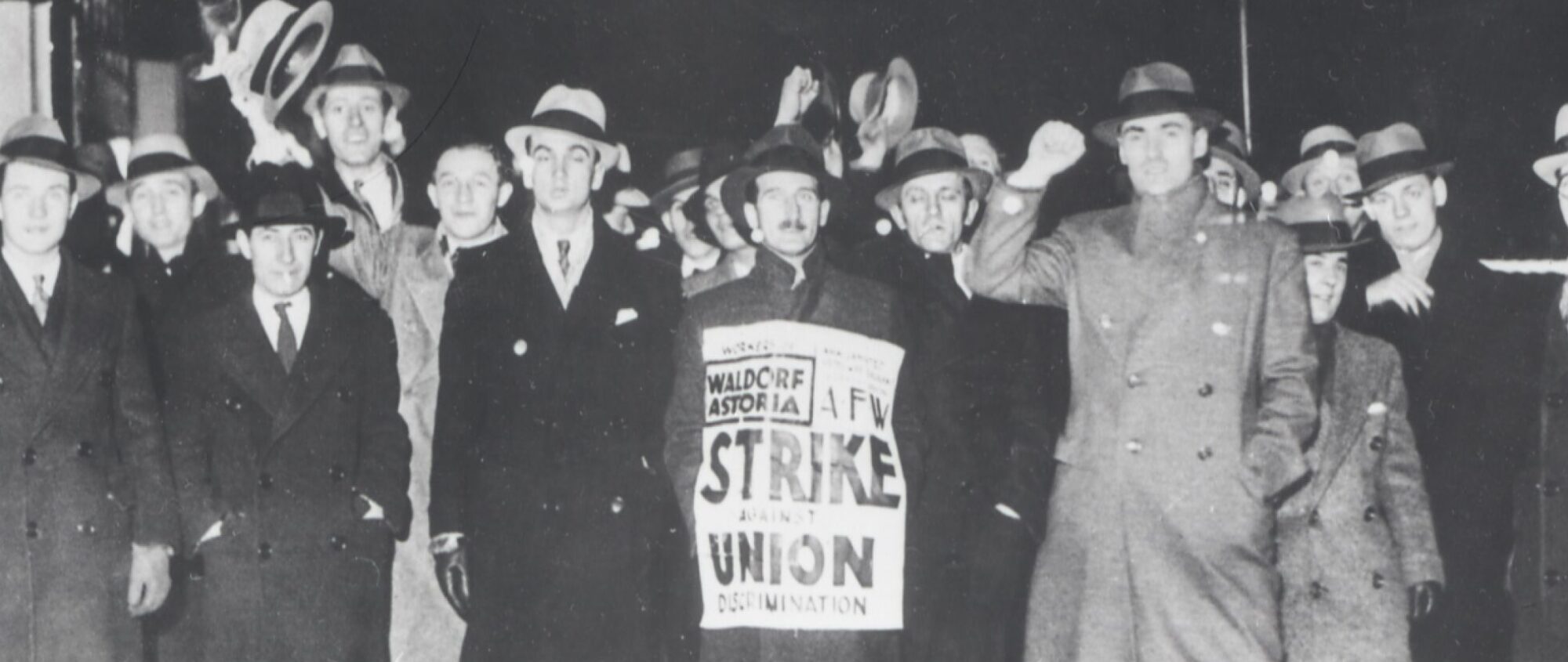
What gall! TWU was actually the first union to be recognized and sign a contract with the city of New York. That’s because the union was first organized in the 1930’s when the city’s bus and subway lines were owned and operated by private corporations. The union struck for and won greater wages and benefits back then, and the strikes were 100% legal. The New York City Transit Authority took over in the 1950’s, and the transit workers became public sector employees and lost their “right” to strike. Same workers, same job, same union, same contract. First legal, then illegal, but not because the idea of a transit strike became “unsafe” or more of a disruption, but simply because the new Boss had the ability to set the laws that made the strike illegal. Good for TWU President Roger Toussaint for refusing to submit to Mayor Bloomberg’s monarchistic thinking.
Hey Radiohead! Here’s a Quid
Radiohead have fired a shot across the bow of the record industry by making their upcoming record, “In Rainbows” available for download for any price that the consumer chooses. “No really, it’s up to you,” the band’s website reassures the fan who is unsure how much to pay for the download. The band’s use of the honor system has produced a cottage industry of articles predicting the End Of The Record Industry As We Know It (EOTRIAWKI) or confessing how much one paid for the download.

Apparently, one third of listeners paid nothing for the download. If the RIAA had their way, these people would be sued for $220,000. But, on average, fans have paid about $8 for a download that – like all records – could be had for free. Me, I paid one pound, 45 pence – about three American dollars. It’s more than I’ve ever paid for Radiohead’s music (a telltale sign of EOTRIAWKI). Perhaps I’ve been too turned off by their hype as the band that will kill guitars and rock-n-roll, but my entire Radiohead collection consisted of an illegal download of the song, “Karma Police” until now.
Lost in the hubbub is the fact that “In Rainbows” is a terrific record. The usually ponderous ballads featuring Thom Yorke’s wailing sound haunting and mesmerizing spaced out in between propulsive rockers like “Bodysnatchers” and “Jigsaw Falling Into Place.” Knowing this in advance, I’d have gladly paid eight dollars for the joy of owning the record.
Labor’s Cold Warriors: Meany, Dubinsky and Shanker
I’d prefer a better term for it, but I think of myself and my peers as being a part of the “Sweeney Generation” of the labor movement. We’re the kids who were recruited to beleaguered labor unions to organize greater numbers of workers as part of a grand movement for social justice (That was the idea, at least). It is hard to believe that if I had come of age thirty years earlier, I’d likely have viewed the AFL-CIO as the AFL-CIA – a pale, male and stale dinosaur that was to the right of most presidents of the U.S.A. in prosecuting the Cold War. Thanks to some inherited books, and Richard Kahlenberg’s new biography of Al Shanker, I’ve recently subjected myself to a history lesson on some of labor’s biggest Cold Warriors.
As head of the AFL-CIO from the time of the merger in 1955 until 1979, George Meany earned the enmity of the left as a symbol of everything that was wrong with the official labor movement: a cigar-chomping bureaucrat who planned Executive Committee meetings around golf games at Miami Beach, a sexist, homophobic coward who enthusiastically supported the Vietnam War but had to be dragged into the civil rights movement. Archie Robinson’s “George Meany and His Times” is a hagiography that might as well be a ghost-written memoir, fleshed out as it is with extensive quotes from public speeches and hundreds of hours of interviews that Robinson conducted with Meany. It is, as Robinson promises, “the real Meany,” so if the man comes off as repugnant as his negative reputation on the left, it’s his own fault, his own words. Take, for instance, Meany’s account of the 1972 Democratic national convention, the most liberal convention the party ever had:
“We listened to the gay lib people – you know, the people who want to legalize marriage between boys and boys and legalize marriages between girls and girls…We heard from the abortionists and we heard from the people who look like Jacks, acted like Jills, and had the odors of johns about them.”
Meany was a business unionist through and through. To him, it never seemed more than a job. On his first job as a Plumber’s union staffer: “there was a financial attraction there because the business agent’s pay was maybe twenty percent higher than a journeyman’s pay, and it was a year-round job.” On becoming President of the NYS AFL: “It was very tiring and all that, but, hell, I was a really young man and had no idea of going any other place. After one year in the job, they doubled my salary.” On being elected Secretary-Treasurer of the national AFL: “I was not looking for a change, but I got to thinking it over: After all, this is what I am doing. I am in the labor movement. This is my life, more or less, and this is definitely a big promotion.” On succeeding William Green as president: “I had been pretty much in charge of running the AFL from 1947 on. Green was perfectly content to let me handle it. So, when he died I felt that I was entitled to the job.”
Meany did not report any great revelation that caused him to oppose Communism. It was simply a matter of seeing that Communists were effective organizers and seemed determined to take over trade unions that made young Meany an anti-communist out of a sense of self-preservation for his well-paying jobs. In later years, he gave his anti-communism the intellectual veneer of preserving freedom, noting that Communist regimes turned independent trade unions into puppets of the state – a charge that is mostly true but which seems like a rationalization that he borrowed from others in order to cover for his own lack of ideological convictions.
David Dubinsky, at least, had an ideology, a core set of beliefs that guided his actions. Dubinsky’s autobiography, “A Life With Labor,” contains some welcome insight into how CP-front Trade Union Education League activists operated inside and outside of the ILGWU, and even provides space for “the other side,” in the form of Charles Zimmerman, an ILG Vice President who had started out as an opponent of Dubinsky’s in the 1920’s. Zimmerman describes the discomfort of following CP policy, as dictated from Moscow, which led party activists to embark on a dangerous strike policy that nearly decimated the union so that one Party faction could score points over another, and how Stalin and Bill Foster led Communists into the ILGWU to “bore from within” and then back out to form a “revolutionary” dual union and back inside the ILGWU again in the space of a few short years at the expense of a good deal of credibility and goodwill.
Dubinsky came out of the heavily-Jewish socialist movement on the Lower East Side that had as its pillars the Socialist Party, Jewish Daily Forward newspaper and the Amalgamated Clothing and the Ladies Garment Workers unions. For him, the battle with the Communists was ideological and stemmed from the very split of the CP from the Sp in 1919, over whether to follow directions from Moscow. Dubinsky’s anti-communism made him an inveterate splitter. After taking the ILGWU out of the AFL to form the Congress of Industrial Organizations, Dubinsky’s was the first union to split from the CIO, partly over the role of Communist organizers, and back into the AFL after CIO resources helped him rebuild his union. In New York State, he split from our splendid American Labor Party because he felt Communists had too much influence. The ALP was a “fusion” party, created to provide a second ballot line for liberal Democrats (indeed, the party was created in order to entice all those Lower East Side Socialists to vote for Roosevelt’s re-election in 1936, without having to cast ballots for Tammany Hall’s Democratic line), but the party also ran a good number of leftist independents – Socialists, Laborites and a few Communists – who won offices ranging from City Council to US Congress. The Liberal Party that Dubinsky created and which replaced the ALP became much more narrowly a Democratic pressure group, and steadily moved to the right along with the Democrats over the ensuing decades. In the end, after Dubinsky died, it became the power base for Rudy Giuliani.
Nobody carried the ideological load of anti-communism as defense of freedom as much as Al Shanker, who is given a glowing portrait in Richard Kahlenberg’s “Tough Liberal.” it is an excellent biography that is marred by Kahlenberg’s clumsy title refrain and enthusiastic party-line reporting on an obscure sect of the socialist movement, called Social Democrats USA, who influenced much of Shanker’s thinking (and who comprised much of his staff). SDUSA started out as the old Socialist Party of America, until, after a series of splits, “it finally got down to this small group that sort of agreed with each other,” in the words of Sandra Feldman. What they agreed with each other about was that it was more important to be against communism than to be for socialism.
Shanker is the father of teachers unionism, organizing the United Federation of Teachers union in New York City and leading the union to strike for collective bargaining rights and higher salaries in the early 1960’s. In the late 1960’s, he led the union on a series of divisive strikes against community control of schools, when a black-led community group took control of the public schools in the ghetto neighborhoods of Ocean Hill and Brownsville in Brooklyn. The strike left Shanker with a lasting reputation as a racist and as a man who, in Woody Allen’s satirical estimation, would use a tactical nuclear warhead in a contract negotiation. Kahlenberg successfully rehabilitates Shanker’s role in the dispute, documenting the community control group’s hard-line refusal to compromise and the simmering anti-Semitism of the group that fired and barred white, Jewish teachers from working in schools where the majority of students were black. Kahlenberg does a slight disservice in this account by not seeking to represent “the other side,” but otherwise makes a persuasive case that Shanker did the best that he could for his members under difficult circumstances, and that failure to protect unionized teachers from racially motivated terminations would have fundamentally weakened the movement towards teachers union organizing.
Kahlenberg points to Shanker’s example and finds a model for “tough liberalism” the Democratic party to emulate in order to recapture the votes of the white working class. Kahlenberg (and Shanker) emphasize a central focus on economic and class issues, and have no quarrel from me on that score. Furthermore, the author points to Shanker’s role in the education reform movement and finds in professionalism, shared governance and white collar unionism a prescription for a revitalized labor movement, and again I find room for agreement. However, when Kahlenberg lauds Shanker’s color blind emphasis on civil rights and promotion, he misses the special role of racism in this country that has reduced black Americans to a caste, a role that requires affirmative action to address. And, finally, when Kahlenberg praises Shanker’s “muscular anti-Commmunism” and calls for the left to return to a vigorous internationalism in moving other nation’s towards “democracy,” I see a history of imperialism and the folly of the kind of adventurism that leaves US Armed Forces stuck in quagmires like Vietnam and Iraq. Al Shanker left a proud legacy at the American Federation of Teachers. The last vestiges of anti-communism, however, are one part of the legacy that has to go.