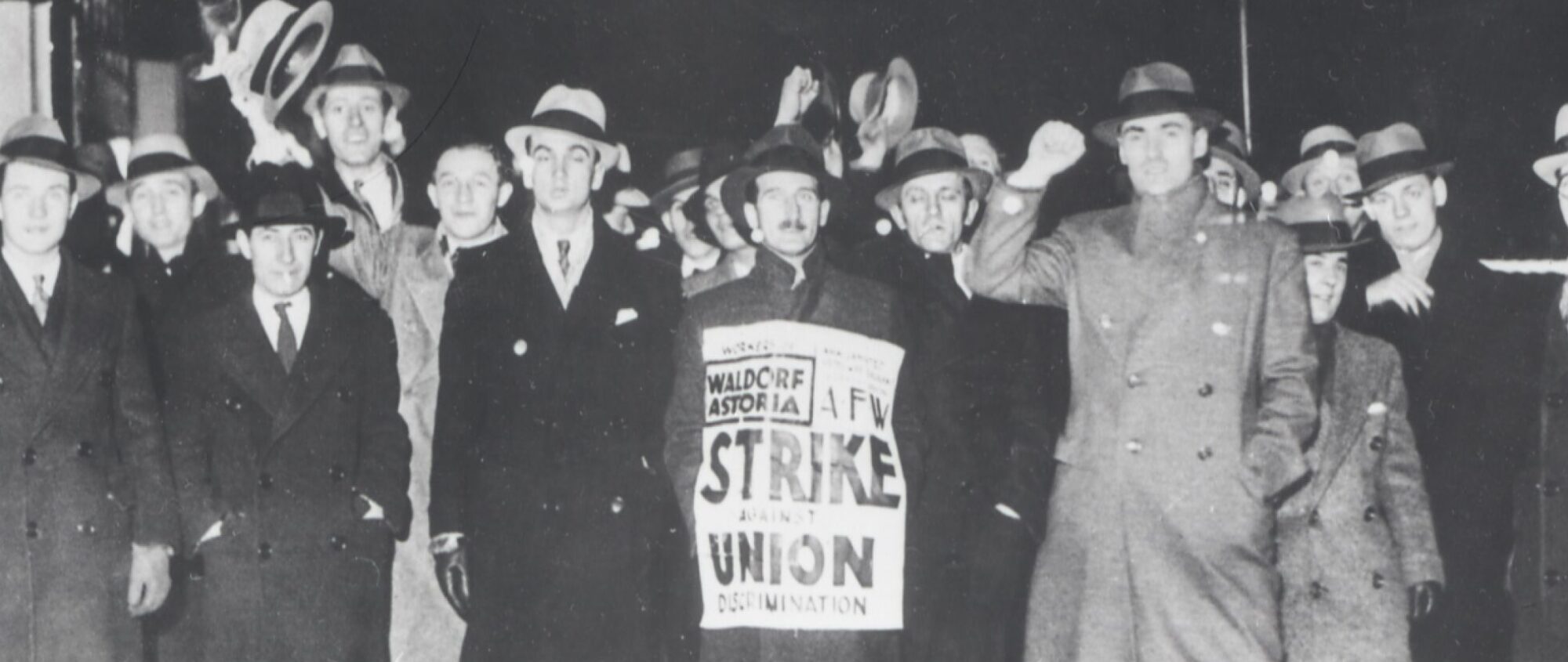
Questions Over Union Neutrality
SEIU’s been facing an increasing amount of scrutiny from the press and from the left lately for its unconventional approach to bargaining to organize. This has been prompted in large part by the California Nurses Association’s controversial decision to intervene in a carefully negotiated and long-planned “neutrality” organizing campaign by SEIU in Ohio, and SEIU’s shockingly violent response at the 2008 Labor Notes conference. In the midst of this controversy, the Wall Street Journal reports details of some of these “secret organizing deals.” The website requires subscription, so I’ve posted relevant quotes below:
Two of the nation’s largest labor unions have struck confidential agreements with large employers that give the companies the right to designate which of their locations, and how many workers, the unions can seek to organize.The agreements are raising questions about union transparency and workers’ rights. A summary document put together by the unions says it is critical to the success of the partnership “that we honor the confidentiality and not publicly disclose the existence of these agreements.” That includes not disclosing them to union members.
[snip]
The agreements reached with Sodexho and Compass in 2005 give the companies “the right to designate the sites” where unions may try to organize workers, according to a confidential summary of the agreements reviewed by the Wall Street Journal. The companies wouldn’t comment on how locations were selected for organizing.
The agreements, which expire at then end of 2008, stipulate the number of employees that the unions can try to organize: 11,000 Sodexho workers and 20,000 Compass workers.
The unions gave up the right to strike and to post derogatory language about the companies on bulletin boards. With Compass, the unions agreed to these restrictions “anywhere in the world.” In exchange, the companies agree not to oppose union organizing at the designated locations.
But limits are also set. “Local unions are not free to engage in organizing activities at any Compass or Sodexho locations unless the sites have been designated,” says the confidential summary.
Mr. Stern said that if workers wanted to join a union at a location the companies had ruled out, having these agreements would enable a union to negotiate on the matter. “If workers want a union we can discuss that,” he said. “Trust me, a lot more workers are coming in than being excluded by the agreement.”
[snip]
The agreements enable the unions to organize workers through a simple card-signing process in which the companies agree to remain neutral, rather than a secret-ballot election. The companies agree to provide the unions with lists of employees and access to workers. The unions give up the ability to strike and agree that they will present issues before a labor-management committee before engaging in leafleting or rallies.
These organizing deals need to be put into the context of the bloody war most employers will fight against a unionization drive, that results, for instance, one in five union activists being fired for union activity. There’s lots of material on the web about how nasty the fight can get and how few true protections workers have these days, so I assume anybody reading my website is familiar with this.
One of the main reasons that employers fight organizing drives so viciously is that with unionization of private sector firms hovering around eight percent, a union contract really can affect a firm’s competitiveness. As traditional organizing tactics have failed to bring employers to the table, unions have relied increasingly on huge (and hugely embarrassing) P.R. and community campaigns to force employers to recognize a union and agree to a contract. Smart employers have begun to take themselves out of the fight by signing the kinds of deals profiled in the WSJ piece. I don’t have any theoretical opposition to these kinds of agreements, and for the most part I think it’s a smart way for union’s to marshall their resources against the truly intransigent employers and to increase density for future bargaining.
The problem that I do have with SEIU’s application of this strategy is that the future always gets further and further away. As noted in the article, the “no strike / no disparagement / no organize” clauses of these agreements have expiration dates. As long as they are relatively brief, workers aren’t really losing much. A bottom up organizing campaign at any worksite with more than 1000 employees can often take two years or more anyhow. If the workers are impatient, the union can potentially re-negotiate the neutrality deal to incorporate a hot shop. Failing that, the workers are free to organize with a different union (although, without neutrality, good luck to them).
Without the ability to strike, unions are only able to win modest wage and benefits improvements and very little in terms of the “work rules” that make the biggest impact on the quality of one’s working life. As long as we’re talking about a two or three year period that allows the union to get its foot in the door at one employer while fighting to drag his main competitors to the table in order to bargain for greater gains at all of the employers in the next contract cycle, what’s the problem? The problem comes from these agreements being stretched out for longer and longer – seven or eight years in some cases – while the union fetishizes “density” at the expense of meaningful contractual gains for the new members it has organized. SEIU, I’m sure, is not unaware of this conflict. In my brief stint as an SEIU organizer three years ago, I worked on a home care organizing campaign that went down in flames. Part of the reason was that some of the employees, who make so little that they work for two or three agencies at the same time – already were SEIU members at their other jobs. They voted as a bloc against the union, in part because they hasn’t felt that being in the union had made an impressionable difference in their lives.
This problem is compounded by SEIU’s reorganization of smaller locals into giant “megalocals.” SEIU is ostensibly aping the structure of the giant corporations it goes up against to better marshall resources against them. Obviously, however, this means a significant curtailing of local union democracy and naturally serves to minimize voices of dissent. Andy Stern and Dennis Rivera, who both had to run insurgent campaigns in order to “take back” their unions, should be more sensitive to this problem. Speaking cynically, perhaps they are all too sensitive to it. Andy Stern aside, neutrality deals such as these should not be dismissed out of hand by trade union activists. They are a good idea, but anyone negotiating such deals necessarily walks a fine line between density and democracy.
Christ May Be King, But At Least He Spares Us Monarchistic Thinking
Teachers at ten New York City schools went on strike Friday over the high cost of health care, but their union was not sued, their president not imprisoned and their members not fined two days of pay for every day out on the picket line. What gives?
The teachers in question work at Catholic schools in the archdiocese of New York so their union is not subject to the same draconian law that would apply to the city’s public school teachers. Is their strike not a “disruption” in the lives of the parents who enroll their children there? Do Catholic school-kids not rely on the structure and safety of the classroom as much as public school kids? Of course not. The simple truth is that while Catholic school teachers might arguably have to answer to a higher law, only public school teachers have to report to a Boss that makes the law and has the power of the state to enforce it. Hell hath no fury like Mayor Bloomberg and the Taylor law. It’s one more strike against monarchistic thinking.
A Cut-Out Bin Classic: “Self Abused” by S*M*A*S*H*
In the rock-n-roll hype that followed “Smells Like Teen Spirit,” the UK had a brief “scene” that failed to take off. Dubbed the “new wave of the new wave,” it was compared to the summer of 1977 (although, doesn’t the N.M.E. compare everything to the Sex Pistols?) and lasted even shorter. The most prominent of the groups, S*M*A*S*H*, failed to make an impact when their only long player, “Self Abused,” landed on these shores. It can’t quite be called a cut out classic, because there probably weren’t copies pressed to put ’em in the clearance bins. This was a pretty hard record to find in 1994, and I’m lucky to still have my copy.
S*M*A*S*H* was a tight power trio, with a hard rock sound, a heavy bottom and lots of great hooks, and oddly fascinating lyrics that leave you genuinely unsure if front-man E. Borrie was a dope of a genius.
The record certainly starts off compellingly, on “Revisited No. 5,” a bombastic heavy metal lament:
Back to where my friend died
Not to the scene of his ugly suicide
but to where he used to live
Just to have him back, anything I would give
This theme of personal tragedy is hinted at on several of the album’s tracks, including the poppy single, “Real Surreal,” whose chorus includes the line “I’m not sad and you’re not dead.” The mixing of anger, sadness and euphoria suggest a real writing talent, but other songs give pause. “Oh Ovary” and “Time” come across like clunky attempts at, like, way deep political philosophizing. Or they could be satirizing the glib liberalism of many rock stars. That Borrie has a sense of humor is confirmed by the oh-so-serious spoken-word bridge on the title track:
I open my mouth and like Chinese whispers
Michael Jackson’s going out with my kid sister
but I’m an only child
You believe what I’ve said?
You’ve been mislead!
Combine the profane with the profound and the pretend, add in references to David Attenborough, the Brontes and Barabas and you have an almost Dylanesque mix. Perhaps Borrie’s most telling line is “Bob Dylan sucks my dick or am I sick?” Partly, it’s a punk rock “kill your idols” statement (and fairly traditional, at that, for its selection of a 1960’s icon). But more than that, it’s a bid to be taken seriously even when acting the fool. It’s a wink to the audience, I like to think, to let you know that this band is as smart as you want them to be. It’s a pity that they so completely dropped off the face of the planet.
Take a Break, Client 9
Born under a lame duck, for most of my living memory we’ve had only two governors in New York. Twelve years of Democrat Mario Cuomo and twelve years of Republican George Pataki. Now, in the blink of an eye, we just burned through another one. I’m not shedding any tears for Client 9, but I am somewhat dumbfounded that he was felled so quickly by something so…trivial.
At Monday’s Labor Research Association awards dinner, NYS Labor Commissioner Patricia Smith stood in for the governor-in-hiding and delivered a pretty convincing defense of his administration’s record. Hundreds of times more wage and hours claims against deadbeat employers than the previous administration. Hundreds of times more health and safety cases investigated than the previous administration. And, yes, he gave over 50,000 early childhood educators the right to organize into unions. Excepting that last one, what is really exceptional about that record? Have politics degenerated in such a way that we consider merely enforcing the law to be noteworthy and commendable?
To my mind, Elliot Spitzer was never a reliable friend of labor and David Paterson will be a welcome replacement (at last, a governor who needs us!). As good as Elliot “Ness” Spitzer’s record was as Attorney-General, after three terms of Republican misrule, voters would have voted in droves for a department store mannequin. Spitzer, like Illinois’ Rod Blagojevich and Massachusetts’ Deval Patrick, translated his lucky landslide as some kind of mandate and declared war on everyone, including his own party and unions like NYSUT when it suited his purpose. Is it any wonder that his opponents in Albany pounced on him the first time he showed an exploitable weakness?
And, boy, is this a story that can be exploited! Already, the two days it took Spitzer to decide to resign gave us time to ponder lots of questions. Questions like, what’s worse: to be Client 8 or Client 10? Why did he choose to book a hotel room under a campaign donor’s name? Because George Fox sounded cool? Well, that’s the last time that guy makes a donation to your campaign fund, Nine. Note to Elliot: next time you’re looking for an alias, do what the rest of us do – read a Dashiell Hammett story and pick the coolest name (“Yes, I’d like to reserve a room. Name: Harry Brazil”). And, finally, what kind of things does Spitzer ask a girl to do that she “might not think were safe?” I’m imagining a well-lubed baseball bat up the backside.
The simplest lesson that any of us can draw from this is that it is high time that we legalize prostitution. The illegality of sex work is the thin veneer of credibility that let the Republicans threaten impeachment and push Spitzer out the door. Applying health code standards and regulation to sex work would doubtlessly improve public health, and, hell, at a thousand dollars an hour, taxing that shit would help keep the Social Security fund solvent for generations to come (or should that be “generations to cum?”). Play safe, comrades. You’re benched, client #9. Batter up, governor #5.