Is It Too Late To Make A Different Choice?
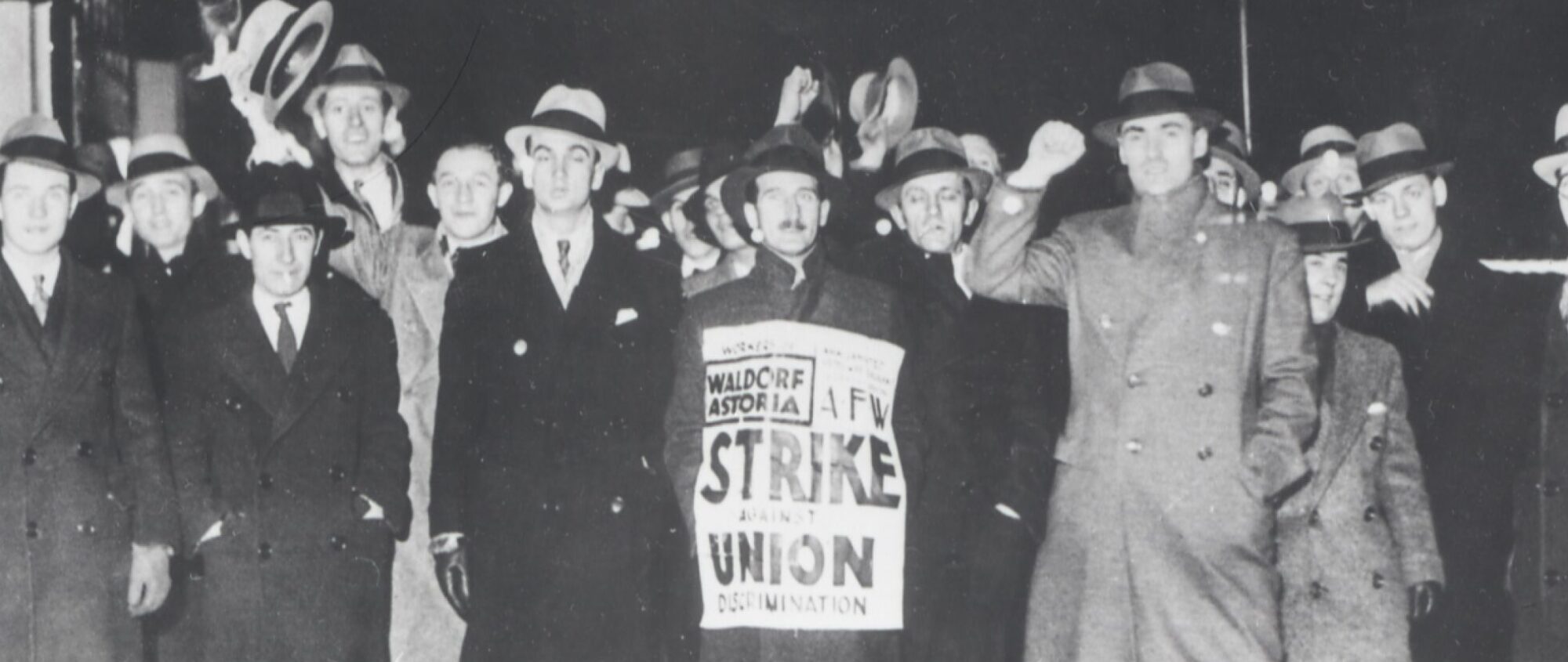
The Employee Free Choice Act might have died this week. Arlen Specter refused a deal wherein labor unions would encourage their members who are registered Republicans to support the Senator in a tough primary in exchange for his vote for cloture. Instead, the entire Republican caucus will filibuster the Act. Now is as good a time as any to ask: Why did the entire labor movement choose to make the Employee Free Choice Act the all-or-nothing focus of labor law reform?
The Free Choice Act is a fairly narrow tweaking of a legal framework that has become a union-busting machine. It does nothing to address so-called “Right To Work” rules that allow scab workers to utilize union resources without paying a dime in dues. It does nothing to outlaw, or even curtail, the use of permanent replacement workers by employers during strikes and lockouts. It does nothing to repeal the sections of the Taft-Hartley and Landrum-Griffin Acts that outlawed union solidarity in the form of unions taking a fight with one employer to a related secondary employer. It does nothing to expand the right to organize to the millions of employees whose rights have been systematically stripped from the Act: supervisors, graduate employees, temps and on and on.
The Free Choice Act does provide for some financial penalties for employers who violate the terms of the act and the basic human rights of their employees. That would be put some teeth in a regulatory machinery that routinely gives employers a slap on the wrist for firing union activists. It would also curtail ability of an employer to thwart a successful unionization effort by subsequently going through the motions during bargaining and never agreeing to a first contract, by subjecting first contract negotiations to binding arbitration after three months. And, finally, it would allow unions to organize through majority sign-up procedures.
I’ve been organizing under a majority sign-up law in New Jersey for a few years now, successfully. Does it make organizing easier? Only slightly. In the private sector, card check has been used very successfully by UNITE HERE and SEIU, usually in combination with a neutrality agreement with the employer. Perhaps that combination of card check neutrality has dazzled too many labor leaders and caused us to put all our eggs in one EFCA basket.
Make no mistake: card check is not neutrality. Even with financial penalties, employers will still campaign against unionization. Employers will still fire union activists and threaten to go out of business. They will be fined, after the fact. In the meantime, union supporters will lose their resolve and give up. Under the curent framework, even after a majority (usually 60% or more) have voted for a union by signing authorization card, they still must vote a second time, some months later after enduring a phalanx of legal hearings, captive audience meetings and the firing of activists. All too often, when that second election is held, many of the employees who had signed cards are frightened into not voting or voting no. All that EFCA gives us, then, is that the initial cards count as the votes, and those votes are impounded at the National Labor Relations Board while the employer beats up and scares the shit out of the employees who voted for the union. EFCA will get you a bargaining unit, but it will not get you a union.
As best as I can tell, the fantasy is that moments after the Employee Free Choice Act is signed into law, the large industrial unions will send hundreds of organizers out into the field to collect cards at major employers in retail, shipping and even manufacturing – Wal-Mart, Toyota and so on – get the cards, get the bargaining unit and get get the first contracts by arbitration. Then, hopefully, with new dues resources, the unions would turn around and actually organize these new union members, gain thousands of new labor voters and press for greater reform. It sounds wonderful, but it it, I believe, a fantasy. Unfortunately, I don’t think that most unions are prepared to run major nationwide campaigns like that. At least not effectively. And at the AFT, the Free Choice Act will do very little for us since most of the private sector workers in our field are still not defined as “employees” under the act.
Gaining card check and doing little with it is far worse than never gaining it at all. Just think of how much fund the Wall Street Journal would have fun with that. Labor gets its dream bill to make organizing “easier” and workers still don’t sign up in droves. It seems to me far better to focus on winning fines against union-busting employers, compulsory arbitration for first contracts and expanding the Act to define as “employees” the workers in the information economy whose unionization is as crucial to labor today as General Motors’ was 70 years ago.
Developmental Diversity
My hometown’s getting a bit of a black eye from the NY Times this weekend. On Friday, the Grey Lady published a profile of Bellerose (a few blocks from my Floral Park and “across the street from Nassau County,” take note), where our local drive-in Frozen Cup ice cream shop is being bulldozed to make way for a new sex hotel.
This is one of many changes, notes Times scribe James Angelos:
The closing of the beloved neighborhood spot strikes many residents as simply the latest sign of the death of old Bellerose. The bowling alley, another local hangout that some considered the beating heart of Bellerose, closed a few years back, to eventually be replaced by a Staples, among other stores. Several years ago, the nearby movie theater closed, and the building now houses a martial arts supply business.
I played in a youth league at the Bellerose Lanes, mind you. My dad worked a part-time job there. I was sorry to see it go, if only because it’s damn hard to find a decent bowling alley in New York these days. Around the same time, two bowling alleys near my old Kew Gardens home also closed down, muscled out by new developers who will likely also replace them with hotels or office supply stores. And when I moved in to Bay Ridge, it was hot on the heels of a protest over the shuttering of the local Key Food grocery store to be replaced by – wait for it – a Waldgreens drug store, while the nearest supermarket, Coney Island’s Pathmark, is swamped with shoppers from four under-served adjacent neighborhoods. It’s all just capitalist development, no? Another example of Jane Jacobs’ theory of success driving out success when it comes to real estate development, leading to numbing homogeneity and the “death of great cities?”
But the Times smells something else at play. At that something else is the faint whiff of curry:
“They’re turning the neighborhood into a third-world country,” Mr. Augugliaro said. “We don’t want it over here to look like Richmond Hill or Jackson Heights,” he added, speaking of Queens neighborhoods with sizable South Asian populations.
As he spoke, Ms. Augugliaro shook her head in disapproval at some of his remarks, and he seemed to pick up on her unspoken criticism.
“I’m not a racist,” Mr. Augugliaro quickly added. In fact, he said, he was tired of the subject of race coming up so often. “What does race have to do with it?” he asked.
Indeed. What does race have to do with it? I have a strange sort of pride that the neighborhood I grew up in is now New York’s Little India; that slumming yuppies make pilgrimages to Floral Park to sample the vindaloo (pity my bland palate can’t handle the stuff); that my parents’ home has quintupled in value, and when they cease to live there, it will be painted purple and adorned with brushed nickel metal accents.
Others, like Mr. Augugliaro (whose name sounds familiar; I think he volunteers for the same community theater group as my folks), are threatened that the changes to the neighborhood look and talk different from the Irish and Italian stock that formerly constituted northeast Queens. But they are letting The Man pit us against each other. The problem is not that another generation of immigrants are pulling themselves up by the boot-straps, buying in to the community and adding a taste of curry to the proverbial melting pot. The problem is that land, and usage, and community service are for sale to the highest bidder, and that local real estate desperately needs some limits and controls placed on it, to ensure a continued diversity of use and community, and that the endless sea of Wal-Marts, Walgreens, Applebees and Home Depots are still dotted with the occasional bowling alley and ice cream shop so that our neighborhoods remain communities.
Champion of American Labor?
Too often Social Democrats are consumed by their grudges. Getting through the biographies they write about their heroes can be a tedious chore. Worse, the subjects of these biographies are poorly served by books that devote more attention to attacking enemies than defending their subjects’ virtues. Arch Puddington’s biography of Lane Kirkland is an egregious offender.
Kirkland, President of the AFL-CIO following George Meany’s retirement in 1979 until he was pushed out of office in the mid-1990’s, presided over an enormously difficult period for American labor. The decline in union density was accelerated by open hostility from the Reagan-Bush administration and a cottage industry of aggressive union-busting consultants, while corporate globalization shipped millions of unionized American jobs overseas. Kirkland’s reputation is as something of a Nero-type character who fiddled with anti-Communist foreign policy while Rome burned.
That is certainly an unfair over-generalization, but “Lane Kirkland: Champion of American Labor” does its subject no favors by devoting several large chapters – almost half the book – to championing Kirkland’s Cold War diplomacy, while tacking on a few dozen pages at the end to document Kirkland’s trade union achievements. Otherwise, Puddington’s book is about settling scores, but even here there is little useful scholarship. Names are invoked as a short-hand. Bella Abzug, without explanation is singled out as an example of hated “New Left” style politics, while Henry “Scoop” Jackson is similarly name-checked as the Great White Hope of the New Deal coalition.
Kirkland is deserving of a critical re-evaluation from a serious biographer, particularly in light of the fracture of the AFL-CIO during the Sweeney-era. It is literally true, as Puddington briefly notes, that the AFL-CIO was never more united, or could claim a larger number of members, than on the tenth anniversary of Lane Kirkland’s tenure as AFL-CIO President, thanks to his assiduous courtship of the unions that left the fold during the Meany years. It is ironic that the large unions that Kirkland wooed back into the House of Labor – the Teamsters, Auto Workers and Miners – played pivotal roles in the effort to oust Kirkland from office a few short years later. Unfortunately for the reader, Puddington shares no insight into the breakdown of support that Kirkland suffered amongst these unions.
To his credit, Kirkland was an early and insightful critic of NAFTA trade policies, and could voice an opposition that was internationalist in orientation. And, contrary to the popular image of him, Kirkland did take modest steps to tun the tide of labor’s declining fortunes. Readers (including myself) may be startled by the reminder than Kirkland started the AFL-CIO Organizing Institute which has trained a generation of organizers.
Future labor scholars would be better served by a new Kirkland biography that pays more attention to these chapters of his life, as well as conducting a more critical evaluation his aggressive involvement in foreign policy. A key question to be explored is the influence of Kirkland’s career path on his executive decision-making. Kirkland was the first president of a labor federation to not only not rise from the rank-and-file or elected office, but to have never been employed as an organizer or Business Agent. Having never cut his teeth on the core functions of a labor union, could that have influenced Kirkland to focus energy and resources on foreign policy work that most union leaders would skip? Could it have deprived him of the political calculus to know when you’re losing the support of your board?
It’s Hard To Find a Soft Cadre
In Michael Harrington’s remarkable deathbed autobiography, “The Long-Distance Runner,” he describes attempting to pick up the pieces of the shattered Socialist Party and a movement split between “Old” and “New” Lefts. The Democratic Socialist Organizing Committee that he formed from his old wing of the party and the diaspora of unaffiliated socialists in the labor and feminist movements was structurally a “mass” organization (albeit, one with few illusions of attracting the masses to it) with a soft cadre at its center.
This terminology, Harrington notes, would be foreign to all but the .0001% of Americans who have spent any time in the organized sects of the left. A cadre are the people who give some internal coherence to an organization. The people who write and photocopy fliers, raise funds, sweep floors, attend meetings and caucus for votes, and so on and so forth. In a Leninist model, this cadre operates with a fairly tight discipline and a democratic centralist decision-making process. Translated to what my 14-year-old cousin would call “normal talk,” that means that the group has an internal debate, following which all members “toe the party line” and carry out the decision of the majority. It also means that no one can join the organization who is not vouched for by a member of the cadre. (Although we don’t use these terms in the context, political campaigns and union organizing campaigns follow similar principles.)
Harrington graduated from an arcane milieu of “anti-Communist, Leninist democratic sects.” Although DSOC (later, Democratic Socialists of America) took all comers, there was a soft cadre at its center – prominent intellectuals and labor leaders, as well as more anonymous volunteers – who nudged the broader organization towards its ecumenical bridge-building envisioned at its founding. One primary challenge, Harrington noted, is that each successive generation has less of a tradition of the movement and less ability to form a coherent cadre. The problem has obviously worsened in the two decades since Harrington published “The Long-Distance Runner.”
Harrington has the decency to note that the old Socialist Party died in a three-way split. Most scholars only deal with the two most prominent factions: Harrington’s and the majority Social Democrats who drifted towards the neoconservatism of Reagan and Bush. The third faction, which kept the name of the old party, provides little of scholarly interest. It is there that I cut my teeth politically. There is probably a paper to be written about the failed experiment of the new Socialist Party in attempting to recreate the mass-based party of yore without the benefit of an intellectual cadre, and, lately, without the benefit of a culture or tradition of the movement. Instead, each successive generation (a generation here being two or three years) joins the party cold after reading some inspiring speech of the long-dead Eugene Debs, and proceeds to engage in pointless faction fights over bureaucratic details (what is to be the name of the magazine, whom shall appoint the members of the International Commission) that are divorced from the actual politics of society.
We do need a socialist party, but first we need to rebuild the cadre for democratic socialism. The first step must be some kind of think tank, which can limit its membership to only the most serious and comradely of comrades, and pt out useful material (studies, statements, blogs, etc) that could find an audience in the greater number of Americans who consider themselves socialists but do not belong to any explicitly socialist organization. With a cohesive cadre and a modest audience, then, and only then, can we consider forming a new socialist formation that is open to any who would join it.